
What Is Vehicle Merchandising? The Used-Car Listing Checklist That Moves Cars
Vehicle merchandising is how a dealer presents each car for sale online: photos, video or 360 spin, description and equipment, price against the market, the vehicle history report, and syndication to the dealer's website and listing sites. Good merchandising gets a shopper to click the car in search results, stay on the listing and contact the store.
For used cars, the listing is usually the first showroom visit. In the 2025 Cox Automotive Car Buyer Journey Study, used-vehicle buyers spent 7 hours 45 minutes researching and shopping online, and 77% of them used third-party sites. This guide covers the six elements, what published data says about photos, and a scorecard you can run on 10 cars. For the layout of the page itself, see what a VDP is.
What are the six elements of vehicle merchandising?
| Element | What it includes | What good looks like |
|---|---|---|
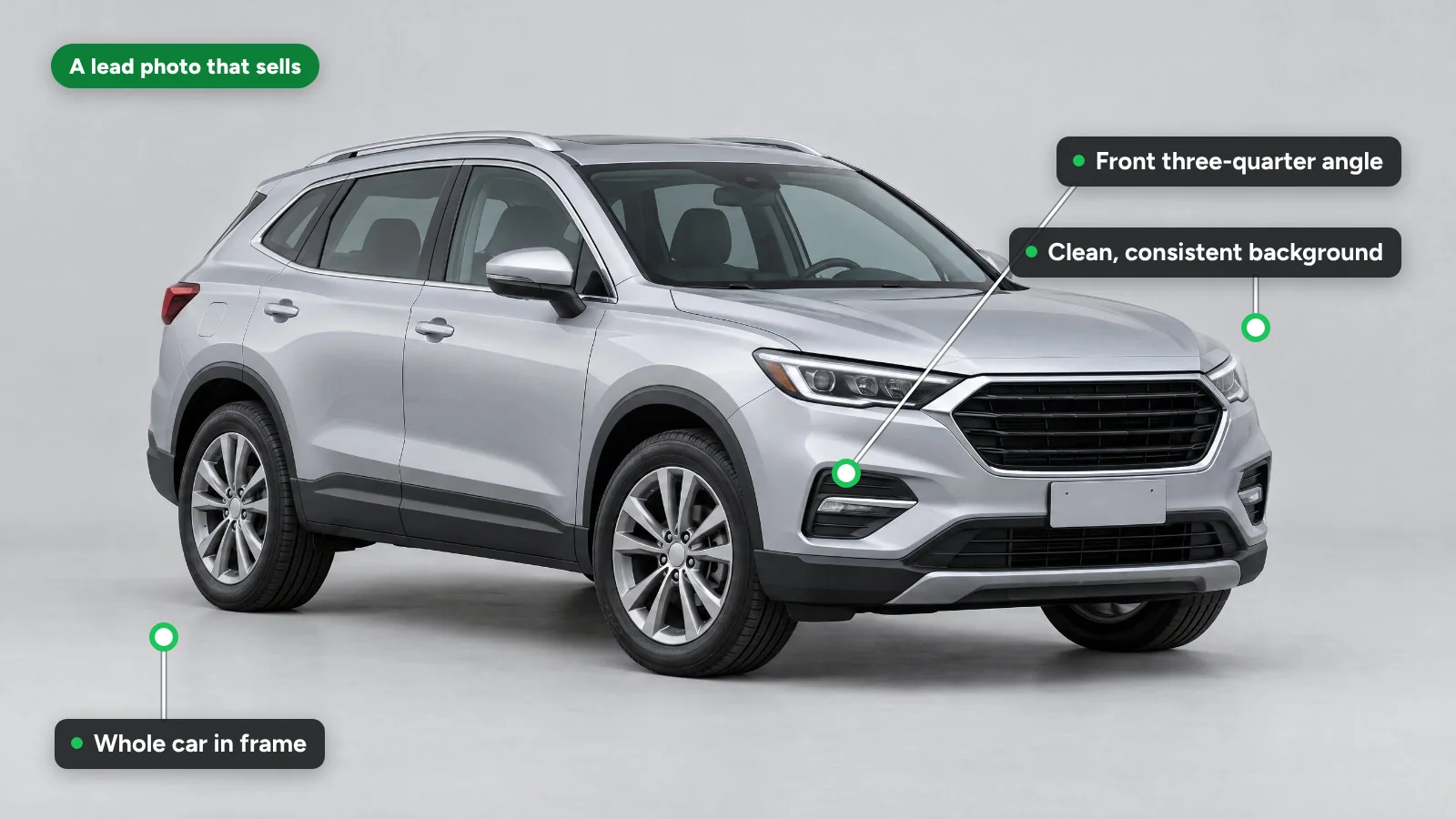
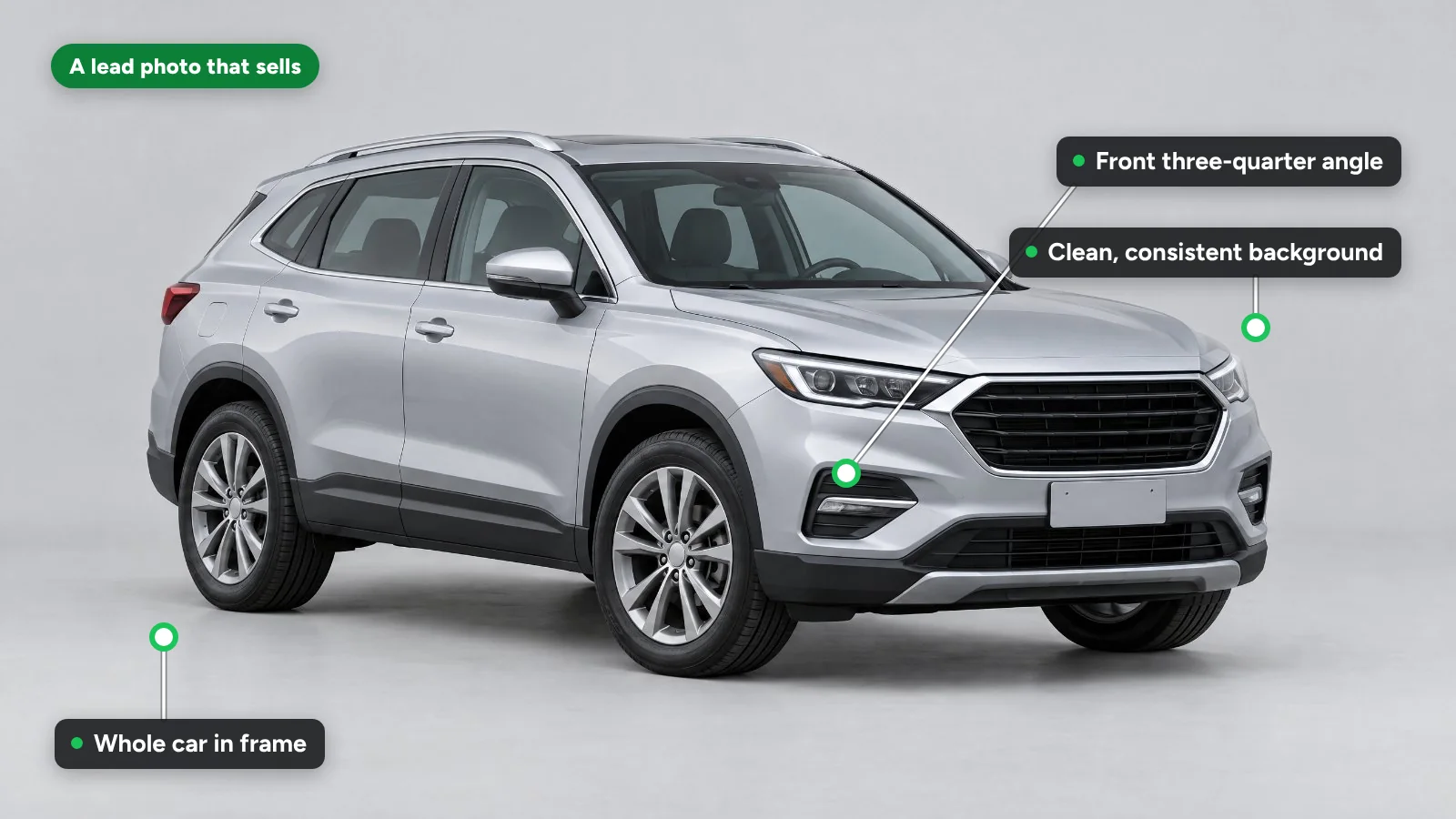
| Photos | Real images of the exact unit, exterior, interior and details | 20+ photos, consistent background and camera height, front three-quarter lead image, unrepaired damage shown |
| Video and 360 | Walkaround video, exterior spin, interior views | At least one of the two on every used unit, made from the same capture as the photos |
| Description and equipment | Trim, factory equipment, options, condition notes, unit-specific comments | Trim and equipment confirmed from the VIN and checked on the car; the first two lines carry the facts that matter |
| Price and market position | Asking price compared with similar listings nearby | An all-in price, reviewed against comparable listings at least weekly |
| Vehicle history report | Accident, title, ownership and service records | Linked on every used listing and consistent with the description |
| Syndication | Your website, listing sites, social and Facebook Marketplace | Same photos, price and details everywhere; sold units removed the same day |
Equipment accuracy also affects how your price is judged. CarGurus rates each listing against its own market value estimate for that car, and says that "Deal Ratings can change when a listing's price, vehicle details, or relevant market data changes." A missing option can make a fair price look high. On price display, the Cars.com Vehicle Listing Policy requires dealers to show "a complete, all-in price for each vehicle."
Does photo quality affect how fast a used car sells?
The published data measures clicks and listing views, the steps before a lead. Here is what we could verify:
- Real photos beat stock photos. In listing data from late 2017, Cox Automotive found that multiple custom photos instead of a stock photo raised click-through to used and CPO detail pages by 349%. Adding price and photos raised used and CPO VDP views by 87%.
- More photos, more views. The same source reports VDP views per listing were 64.8% higher with 40+ photos (January 2018 data). These figures date from 2017 and 2018; we did not find a newer public study with comparable data.
- Photo count affects placement. CarGurus said in March 2024 that "20+ high quality photos are optimal for lead conversion" and that "listings missing photos appear lower in the search results."
- Room for more. Cars.com allows "up to 99 photos for used vehicles."
- Shoppers expect the actual car. In its September 2026 pricing FAQs, FTC staff say that for used cars "it is reasonable for consumers to expect the photo to show the exact car offered for sale."
So do professionally shot photos get more leads? The data shows that complete sets of real photos beat stock or missing photos. We are not aware of a public study that compares a hired photographer with a well-guided phone capture, or that links photo quality directly to days on lot. Completeness and consistency are what the evidence supports.
You can test it yourself. Pick 20 similar used units, reshoot 10 to the scorecard below and leave 10 as they are, then compare VDP views per day, leads and days to sale over 30 days. Example: if the reshot group averages 14 views a day and the control group 10, that is (14 − 10) ÷ 10 = 40% more views. Then check whether leads moved too.
Why do my car photos look worse than the dealer down the street?
When two similar cars sit side by side in search results, the gap usually comes from process, not equipment:
- Mixed backgrounds. A wall in one shot, a row of cars in the next, a service bay in a third.
- Uneven light. Harsh midday sun on one unit, dusk on another, glare across the windshield.
- Shifting angles and height. The lead shot is sometimes front three-quarter, sometimes side, at different distances.
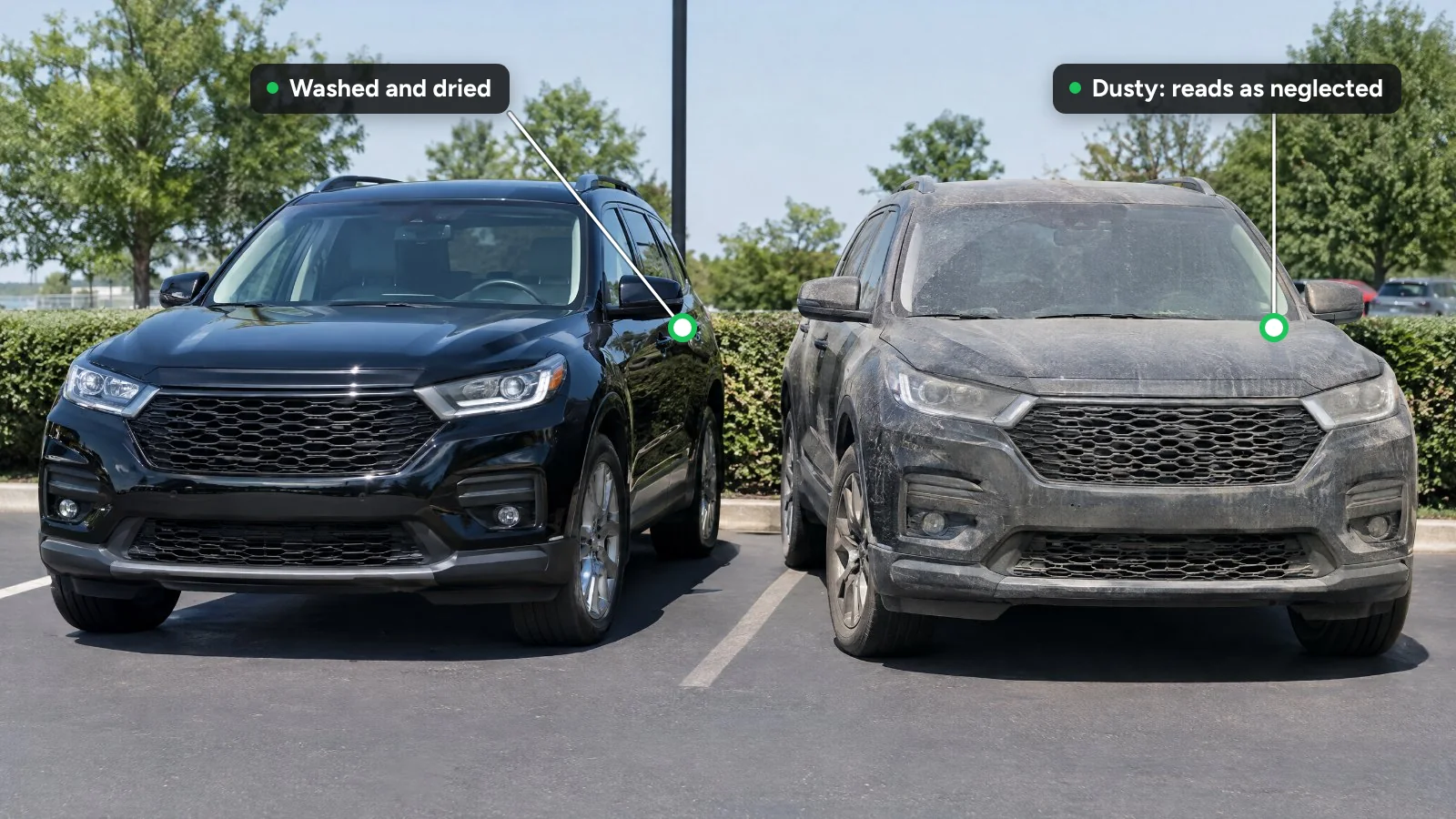
- Dirty cars and clutter. Dust, water spots, a parts tag on the mirror, cones in the frame.
- Low counts. Eight photos against a competitor's 30.
What makes a used car listing stand out online? A 10-point scorecard
Score one point for each check a listing passes. Run it on 10 random used units, including your oldest.
| # | Check | Passes if |
|---|---|---|
| 1 | Photo count | 20 or more real photos of this unit |
| 2 | Lead photo | Front three-quarter, whole car in frame, clean background |
| 3 | Set consistency | Same background and camera height on every exterior shot |
| 4 | Interior and details | Dash, odometer, front and rear seats, cargo area and tires included |
| 5 | Condition | Any unrepaired damage shown in close-up |
| 6 | Video or 360 | At least one is live on the listing |
| 7 | Equipment | Trim and options match the VIN build data and the car |
| 8 | Description | Written for this unit, with key facts in the first two lines |
| 9 | Price | All-in price shown and checked against comparable listings in the past 7 days |
| 10 | History and sync | History report linked; same price and photos on your website and each listing site |
Photo branding is a separate layer. Logos, price banners and plate masking have their own rules on each listing site, covered in our guide to dealer photo overlays.
Who owns vehicle merchandising at a dealership?
- Small independent store. The owner or used car manager owns it. One person, often a lot attendant, does capture, and the manager writes descriptions and sets price.
- Mid-size store. An internet or merchandising manager owns the listing standard, with porters or a photo vendor capturing and the used car manager owning price.
- Dealer group. A central digital or used-vehicle director sets the standard and each rooftop follows it. Our guide to vehicle photo standards for dealer groups covers that governance.
What should you look for in vehicle merchandising software?
Merchandising usually spans several tools. An inventory management platform such as vAuto handles appraisal, pricing to market and stocking. A website platform hosts the VDP. A syndication feed sends listings out. Photo and media tools handle capture, editing, spins and video. When comparing media tools, check:
- Guided capture on a phone with a fixed shot list and quality checks, so any staff member can do it.
- Consistent output: the same background, framing and logo placement on every unit.
- Rules for overlays and plates, applied and removed automatically.
- Accuracy controls: a review step that confirms edits did not change the car.
- DMS connection and sold-status sync, so details come from the record and sold units come down.
- Publishing to your website and listing sites from one capture.
- Reporting: time to live, images per unit and views per unit.
- Pricing model: per car, per rooftop or per seat, and whether a contract is required.
Where does HelloRamp.ai fit?
HelloRamp Studio covers the photo, video and 360 elements. The guided capture app takes staff through a fixed sequence of angles in a phone walkaround of under five minutes, with a per-frame check that flags cropped shots and dirty cars. Studio applies one of 100+ studio backgrounds, masks plates and places your logo in the same spot on every image. On the Pro and Ultra plans, it also builds a 360 spin and a video tour from the same capture.
A trained reviewer checks every image, spin and tour against the original capture through HelloTrust before it publishes. HelloRamp.ai pricing is based on the cars you upload each month, not your lot size. Pricing to market stays with your inventory platform. Dealerships across the US, Canada and India use Studio to hold every listing to the same standard.
Sources
- Cox Automotive: 2025 Car Buyer Journey Study Summary (2025)
- Cox Automotive: Telling your value story through photos (May 2, 2018)
- CarGurus Dealer blog: Improved photo galleries to deliver you more leads (March 12, 2024)
- CarGurus: How CarGurus works (current)
- Cars.com (Cars Commerce): Digital Merchandising for Car Dealers (2026)
- Cars.com (Cars Commerce): Vehicle Listing Policy (2026)
- FTC: Automobile Industry Pricing Transparency FAQs (September 2026)
Frequently asked questions
What is the difference between vehicle merchandising and vehicle marketing?
Vehicle merchandising is how each car is presented for sale: its photos, video, description, price, history report and listings. Vehicle marketing is broader and promotes the dealership itself through advertising, social media, email and events. Strong merchandising makes every marketing channel work harder, because each ad ends on a listing.
What is a vehicle merchandising scorecard?
It is a short checklist that gives each used-car listing one point for every check it passes: photo count, lead photo, consistency, interior shots, condition, video, equipment, description, price and history. Score ten random units, including your oldest, and fix the checks that fail most often.
Who should own vehicle merchandising at a dealership?
At a small independent store, the owner or used car manager owns it. Mid-size stores usually give it to an internet or merchandising manager, and dealer groups set one standard centrally. Whatever the size, name one person responsible for the scorecard and review it every week.
How often should a dealer review used car listings?
Check price against comparable listings at least weekly, and review the full listing whenever a car crosses an age threshold such as 30 or 45 days. Run the merchandising scorecard on a random sample of ten units each month so the same weak spots do not persist across the inventory.
Does a vehicle history report help a used car listing?
Yes. A linked history report answers the questions shoppers would otherwise ask before contacting the store, such as accident, title and ownership records. Make sure the description agrees with it, because a listing that contradicts its own history report costs trust before the first conversation.
HelloRamp.ai is AI visual merchandising for car dealerships: guided capture, daily social publishing and personalised video replies to leads, in one platform. Book a walkthrough using your own vehicles.