
Vehicle Photography for Online Car Marketplaces and Remarketing Platforms
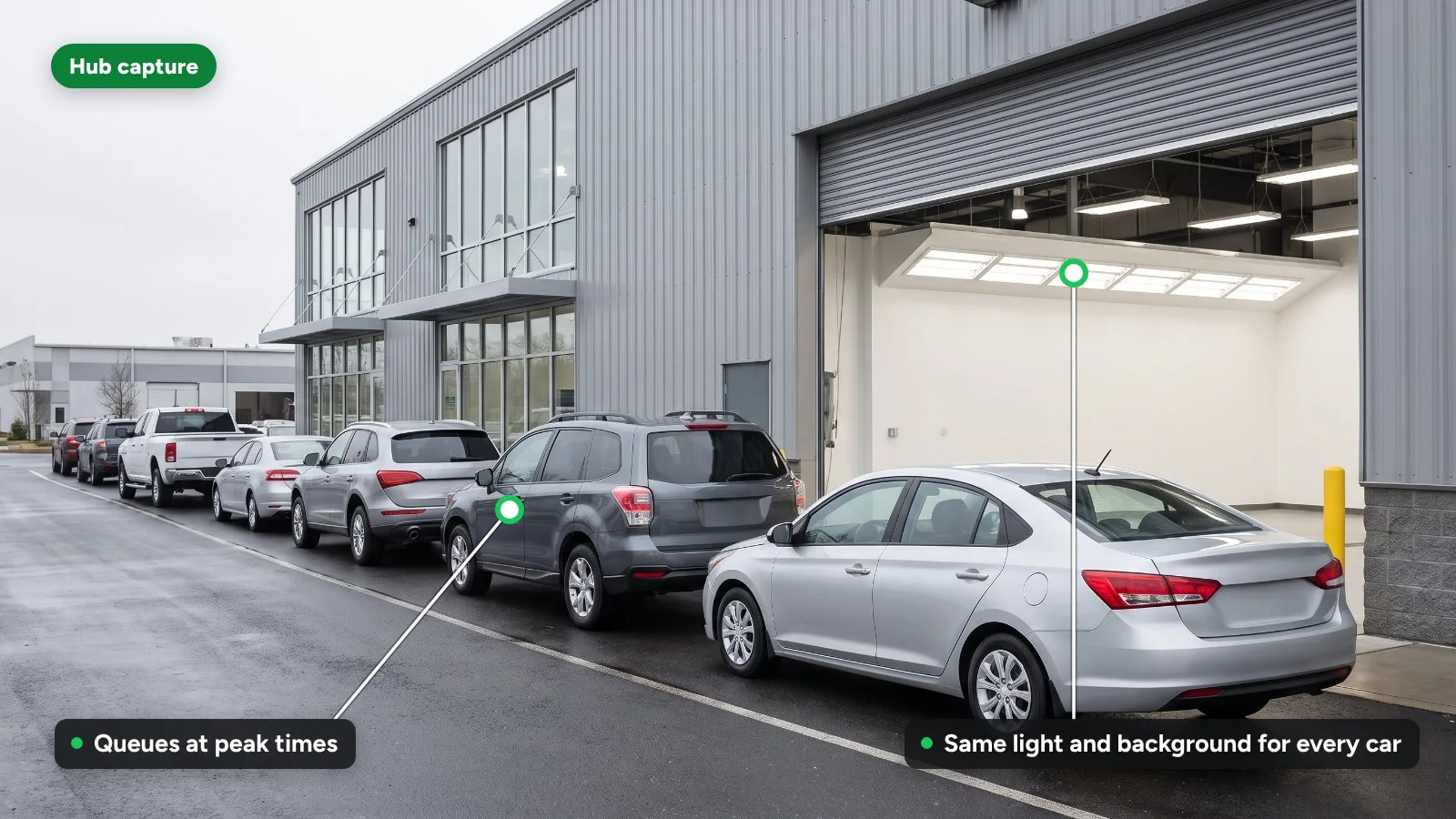
Online used-car retailers and remarketing platforms run vehicle photography as a production line: a fixed shot list, a controlled capture setup at each hub or a guided app in the field, a written rule for photographing damage, and a review step before anything publishes. The photos stand in for an in-person inspection, because many buyers never see the car first.
Wholesale has already moved online. In July 2025, the executive who oversees Manheim's digital operations told Wards Auto that more than 72% of Manheim vehicles are now sold online.
This guide is for operations that photograph thousands of vehicles across many locations. If you run a multi-rooftop retail dealer group, our guide to vehicle photo standards for dealer groups covers that governance model.
Who needs a high-volume vehicle photography process?
Four kinds of businesses share the same problem:
- Online used-car retailers that sell cars sight unseen and deliver them or hand them over at a hub.
- Digital wholesale and auction platforms where dealers bid on cars they will never walk around.
- Fleet, rental and subscription remarketing teams that move off-fleet vehicles through auctions or their own retail sites.
- Inspection companies that send inspectors to dealerships, homes or fleet yards and produce photo-backed reports.
How do online used car platforms handle vehicle photography?
The large players describe their approach in public filings and help pages:
- Carvana says in its Form 10-K for fiscal 2025 that it uses "patented, automated photo technology to offer an annotated virtual vehicle tour" that "allows customers to view vehicle imperfections through high-definition photography."
- Manheim in November 2025 unified the vehicle page and condition report for cars inspected by its mobile inspection team, with damage line items that carry supporting images.
- ACV Auctions tells buyers that its condition report's photos section includes interior, exterior, engine bay, odometer and tires, alongside an undercarriage scan and an engine audio recording, and that features depend on the inspection type the seller ordered.
Hub capture or field capture: which fits your operation?
Most platforms run two capture models, often side by side.
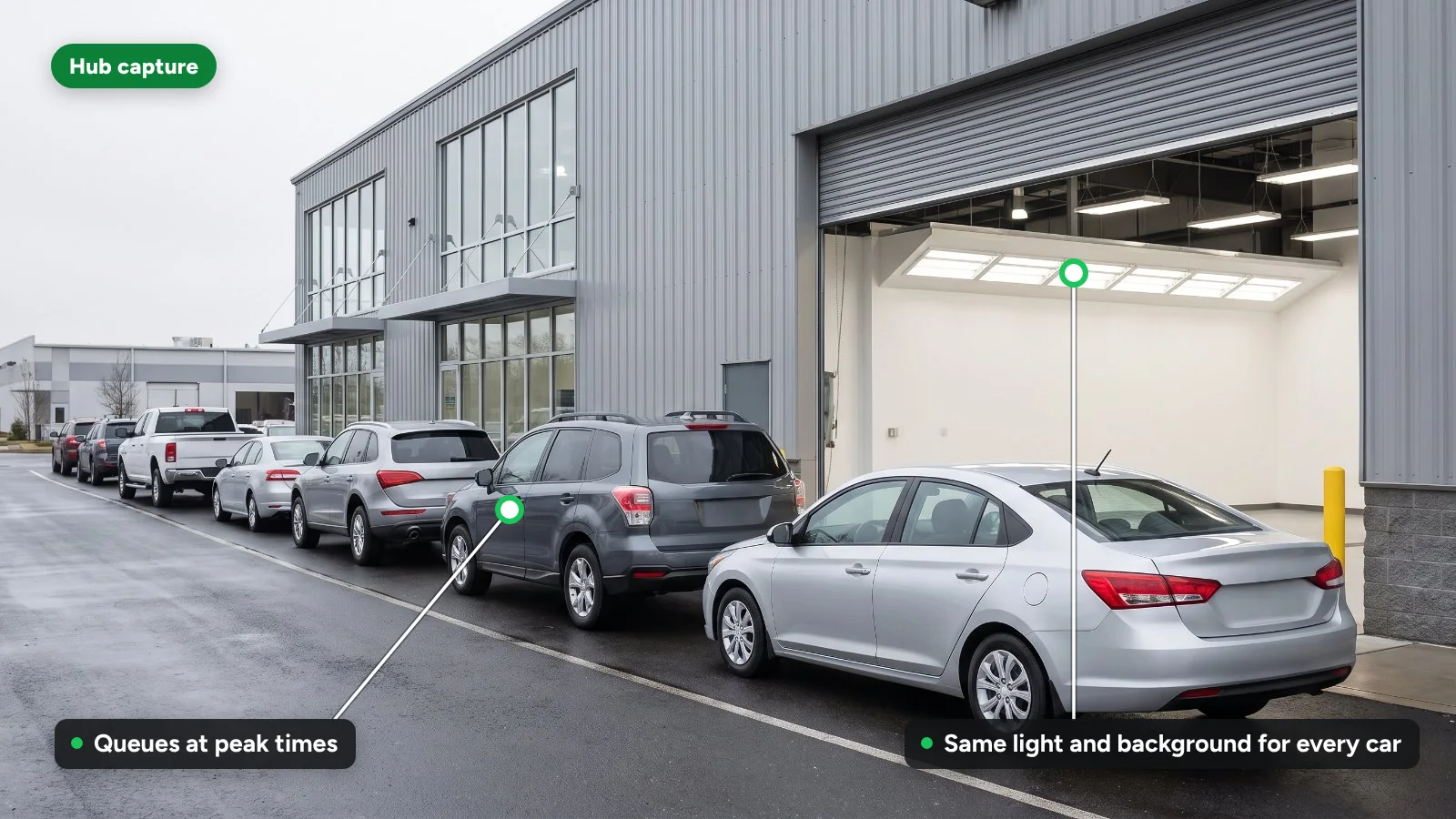
| Hub capture (booth, turntable, lightbox) | Field capture (inspectors or staff with phones) | |
|---|---|---|
| Where it fits | Reconditioning centers and auction sites with steady inbound volume | Dealer lots, fleet yards, homes, low-volume sites |
| Consistency | High: same light, background and camera position every time | Depends on the capture app, training and weather |
| Throughput | Fast per car once running; queues at peak | One person per car; scales by adding people |
| Upfront cost | Building space, equipment and maintenance | Phones, mounts and software |
| Logistics | The car must reach the hub first | Capture happens where the car already is |
| Weather | Not a factor | Rain, glare and short days affect results |
| Main risk | Bottleneck when the booth is down | Drift between inspectors and locations |
Hub capture wins on consistency. Field capture wins on speed to list, because the car does not wait for transport. For outdoor capture in winter, see car photography in bad weather.
What do condition report photos need to show?
In remarketing, photos are part of the disclosure record. Manheim's Digital Buyer Protection policy covers "undocumented visible exterior damage," excludes issues already disclosed in the inspection report or pre-sale documentation, and uses the NAAA Generic CR Position Statement to resolve condition report disputes. The National Auto Auction Association's arbitration guidelines, updated effective June 1, 2026, went further: a vague announcement such as "No Arb for Oil Leaks" no longer protects a seller on its own. Manheim tells sellers to use specific disclosures, detailed condition notes or a Red Light/As-Is announcement.
For photography, that means:
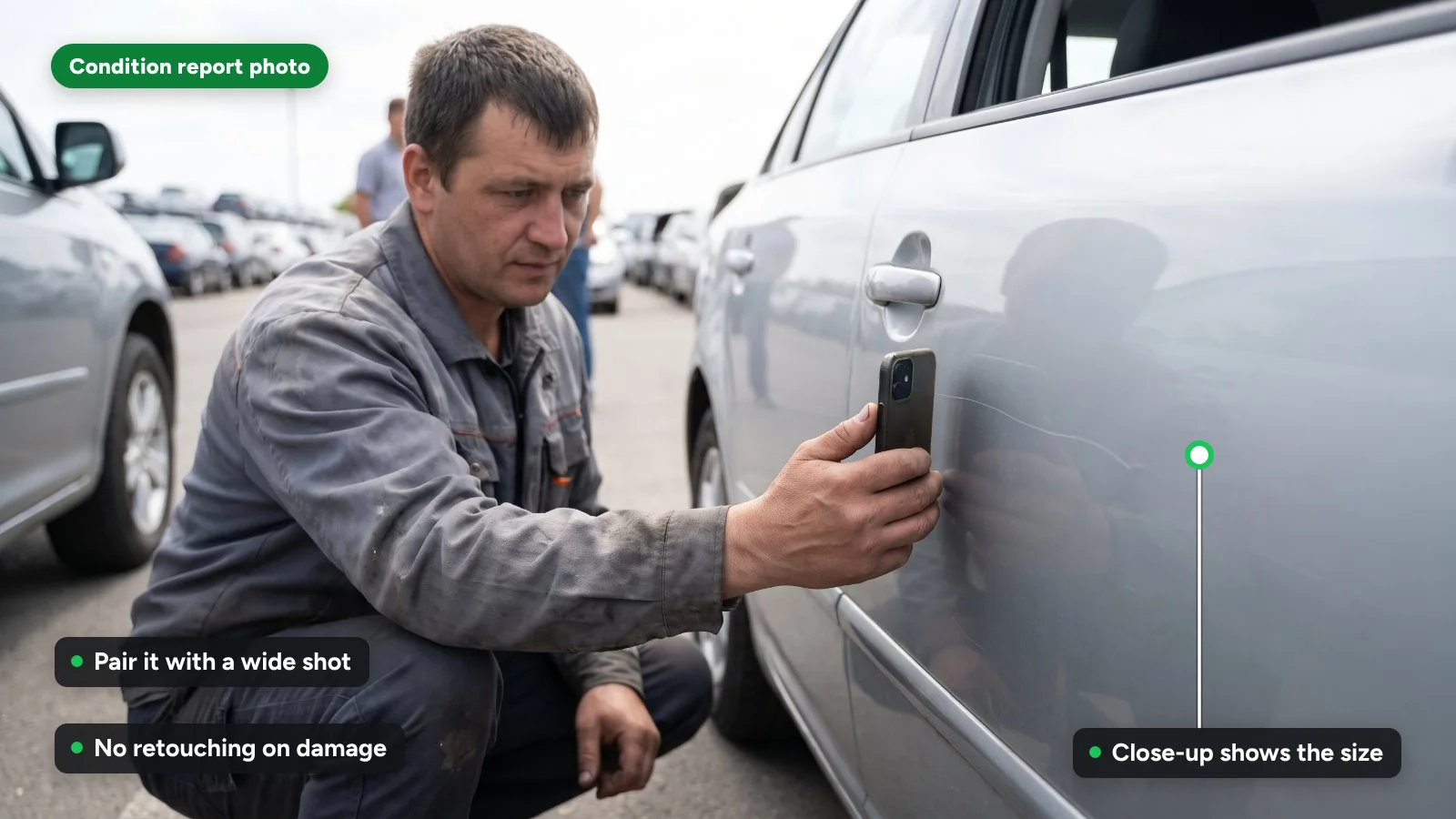
- Two shots per damage item. One wide enough to show where the damage sits on the car, one close-up that shows its size.
- A scale reference in the close-up. A coin or tape measure, where your standard allows it.
- Damage photos linked to the line item. The image and the written description cannot drift apart.
- No retouching on damage frames. Background and color fixes must never soften a dent or scratch.
- Odometer and dash with the ignition on. Mileage and warning lights must be visible.
What should a marketplace photo spec include?
The spec should be short enough for a new inspector to follow on day one:
| Element | Sample spec |
|---|---|
| Lead image | Front three-quarter at about 45 degrees |
| Exterior set | Front, rear, both sides and all four corners, camera at headlight height |
| Interior set | Dash, front seats, rear seats, headliner, third row and cargo area where fitted |
| Identity shots | Odometer, VIN label on the door jamb, keys |
| Mechanical | Engine bay, each tire showing tread |
| Damage | Wide and close-up pair per item, linked to the condition report |
| Background | One approved, uncluttered background per channel |
| Files | At least 1500 pixels on each side, JPEG or WebP, named by VIN and sequence |
The lead angle and file sizes follow Google's vehicle ads image requirements, which set a 500 x 500 pixel minimum, recommend 1500 x 1500 or above with a 4:3 aspect ratio, and recommend a front-to-side main image "at ~45 degrees." For spins on top of stills, see our guide to 360 car photography apps.
How do car marketplaces keep listing photos consistent across hubs?
Consistency across hubs comes from removing choices, not from training alone:
- One central spec, versioned. Every hub works from the same version, and changes roll out on a set date.
- Hub configuration, not hub improvisation. Where hubs genuinely differ (channel mix, brand, local background), record the difference centrally.
- Guided capture. The app or booth prompts each shot in order, so the sequence does not depend on memory.
- Fixed physical marks. Paint the car position and camera positions on the floor at every booth or photo spot.
- Central processing. Apply backgrounds, framing and color correction in one place, not at each hub.
- Reference sets. Keep an approved sample vehicle set per hub and compare new work against it.
- Hub scorecards. Publish the metrics below by hub every week.
Should you review every vehicle or only a sample?
| Approach | How it works | Fits | Risk |
|---|---|---|---|
| Sampling | Review a fixed share of vehicles per hub per day | Stable hubs with low error rates | Bad sets publish between samples |
| 100% review | A person checks every vehicle before it goes live | New hubs, retail listings, edited images | Needs staffing around the clock |
| Automated checks plus review | Software flags missing angles or blur; people check flags and edits | High volume across many hubs | Automation misses subtle edit errors |
Either way, keep an audit trail per vehicle (who captured it, which edits ran, who approved it) and send rejections back with a reason code.
Which throughput metrics should each hub report?
- Capture-to-live time. From capture to published. For the retail version of this metric, see days to photo.
- First-pass approval rate. Share of vehicles approved without a reshoot.
- Reshoot rate. Share of vehicles sent back, by reason code.
- Spec compliance. Share of sets with every required angle.
- Cost per vehicle. Labor, equipment, space and software divided by vehicles published.
We are not aware of a published industry benchmark for capture-to-live time or reshoot rate at remarketing platforms. Set a four-week baseline per hub and compare hubs against each other.
What should a vehicle photography API support?
- Vehicle submission. By VIN or stock number, with the metadata each channel needs.
- Asset retrieval. Finished stills, spins and video, by vehicle.
- Webhooks. A notification when each asset publishes or fails review.
- Per-angle status. One missing frame is visible instead of silently holding up the vehicle.
- Version history. A car reshot after repair replaces old images everywhere.
- Security documentation. Something your IT team can review before integration.
How does HelloRamp.ai support marketplaces and remarketing platforms?
HelloRamp.ai for platforms takes captures from your hubs, your team or an API, applies backgrounds, framing, corrections and overlays, and publishes to your site and to Instagram, TikTok, YouTube, Facebook and Facebook Marketplace, with an audit trail per vehicle. Image processing runs on HelloRamp Studio, and channel publishing on HelloRamp Social. Standards, brands and channels are configured per hub. You can hand over specific hubs, channel distribution or overflow volume, and keep hubs that are already staffed with your own team.
The API lets you submit vehicles, pull finished assets and receive a webhook when each asset publishes. API and security documentation is available on request. HelloRamp.ai works with platforms and dealer groups in the US, Canada and India, and is expanding to Europe and Australia.
Every frame passes HelloTrust review, where a trained reviewer compares the output with the original capture before it publishes. Reviewers approve, flag or reshoot each angle, and flags go back to the photographer with the reason.
Sources
- Wards Auto: Manheim Detroit showcases scale amid industry uncertainty (July 2025)
- Carvana (SEC EDGAR): Form 10-K for fiscal year 2025 (2026)
- Manheim: A new visual experience for vehicle pages (2026)
- ACV Auctions: How to read a vehicle condition report (2026)
- Manheim: Digital Buyer Protection (2026)
- Manheim: What the latest NAAA updates mean for you (May 2026)
- Google Merchant Center Help: Vehicle ads image requirements (current)
Frequently asked questions
How many photos are in an auction condition report?
It depends on the platform and the inspection type. There is no single industry count. Manheim attaches supporting images to each damage line item, and ACV's condition report photos cover interior, exterior, engine bay, odometer and tires, with an undercarriage scan where the inspection includes one.
What is the difference between hub capture and field capture?
Hub capture photographs cars in a fixed booth, turntable or lightbox at a central site, which gives consistent light and backgrounds. Field capture sends inspectors or staff with phones to wherever the car is, which lists cars faster but depends on the capture app, training and weather.
Does photographing damage protect a seller at a wholesale auction?
It helps, but rules vary by auction. Manheim's Digital Buyer Protection excludes damage already disclosed in the inspection report or pre-sale documentation, and since June 1, 2026, NAAA guidelines no longer let a vague "No Arb" announcement protect a seller. Photograph each damage item and tie it to its condition report line.
Should a marketplace review every vehicle photo or only a sample?
Review every vehicle when hubs are new, when images are edited or when listings go to retail buyers. Sampling suits stable hubs with low error rates, but bad sets can publish between samples. Many operations combine automated checks for missing angles with human review of flags and edits.
How do you calculate photo cost per vehicle at a hub?
Add a month's capture labor, equipment, space and software costs, then divide by vehicles published that month. A hub spending $9,000 to publish 2,000 vehicles pays $4.50 each. Multiply by one plus the reshoot rate to include reshoots, such as $4.95 at 10%.
HelloRamp.ai is AI visual merchandising for car dealerships: guided capture, daily social publishing and personalised video replies to leads, in one platform. Book a walkthrough using your own vehicles.