
Car Dealership Inventory Management: Turn, Aging and Where Merchandising Fits
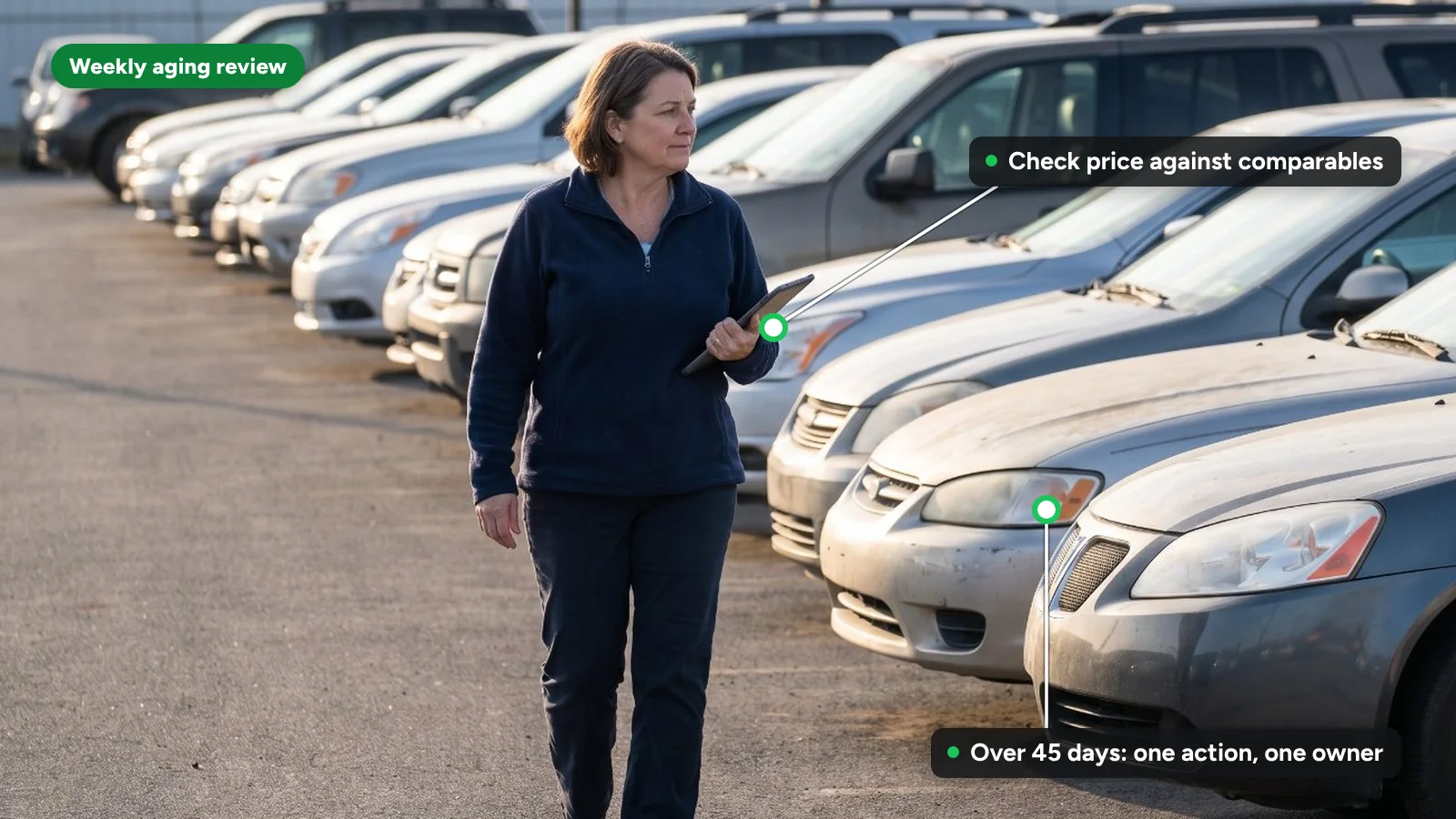
Car dealership inventory management is the work of buying the right used cars, pricing them to the market, reconditioning and listing them fast, then retailing or wholesaling each one before time eats its gross. Two numbers show how well it is going: turn, how often stock sells through in a year, and age, how long each car has sat.
Most stores manage both with age buckets, a weekly review and a 60-day limit. For context, combined franchised and independent dealers had 2.21 million used vehicles on their lots in September 2026, a 49 days' supply, according to Cox Automotive. That is a market figure. Your own store's number can be far higher or lower, which is why you measure it yourself.
What does dealership inventory management cover?
Each used car passes through five stages, and each one adds days:
- Acquisition and appraisal. Trade-ins, auction purchases and cars bought from the public. Buy with a target retail price and a target exit date in mind, not only a purchase price.
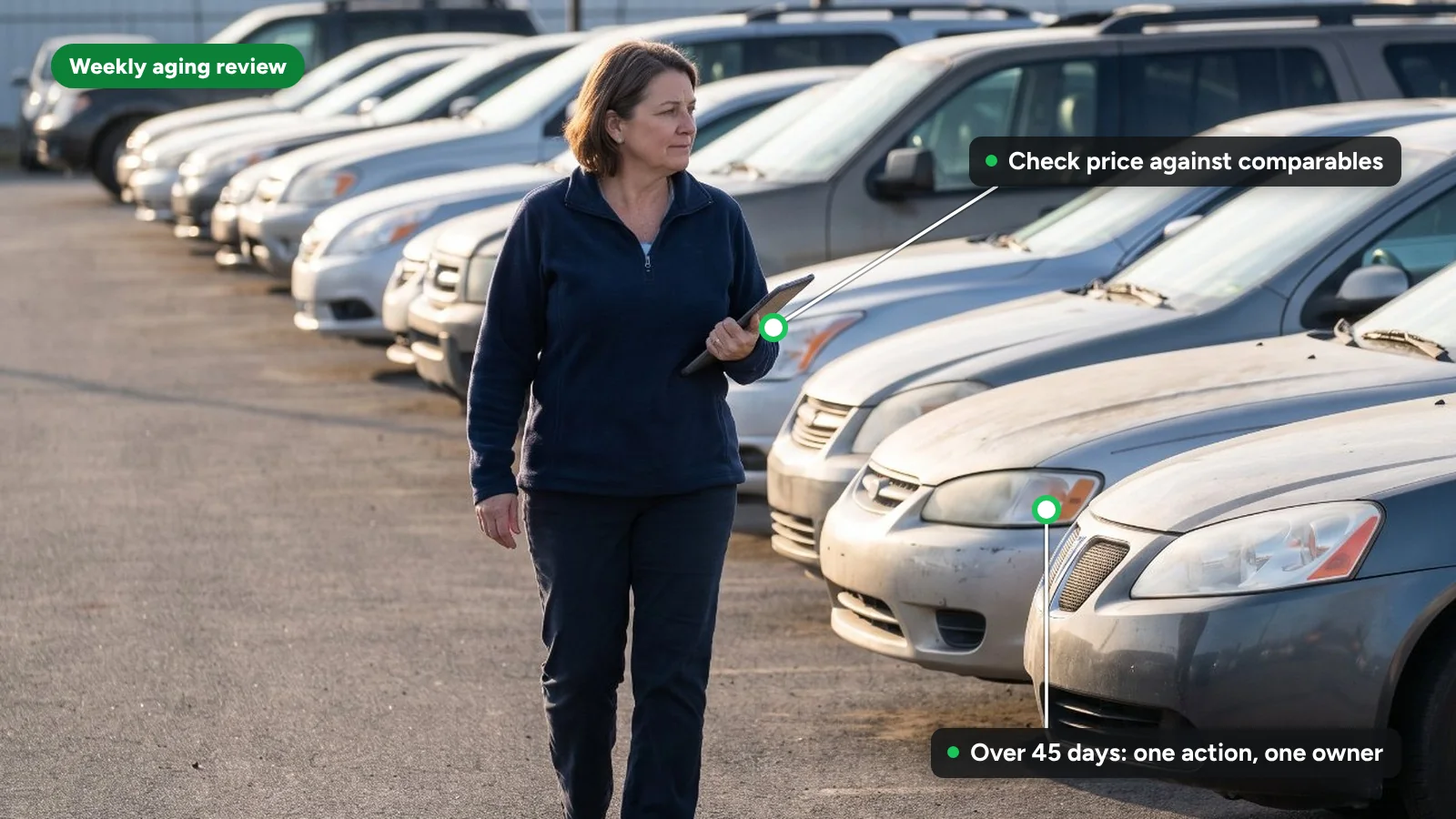
- Pricing to market. Set the price against comparable cars listed nearby, then review it as the market moves.
- Reconditioning. Inspection, mechanical work and detail. Our used car reconditioning checklist covers the steps and time targets.
- Merchandising. Photos, video, description, price display and syndication to listing sites. Our guide to vehicle merchandising has the full listing checklist.
- Aging and exit. Price moves, extra promotion and, when a car will not retail in time, a wholesale decision.
Which inventory KPIs should a used car manager track?
The worked examples below use one example store: 90 used units in stock and 60 retail sales in the last 30 days. They are illustrations, not benchmarks.
| KPI | Formula | Worked example |
|---|---|---|
| Turn rate (annualized) | Monthly retail sales × 12 ÷ average units in stock | 60 × 12 ÷ 90 = 8 turns a year |
| Days' supply | Units in stock ÷ (retail sales in last 30 days ÷ 30) | 90 ÷ (60 ÷ 30) = 45 days |
| Average age | Total days in stock for all units ÷ units in stock | 2,250 ÷ 90 = 25 days |
| % over 60 days | Units older than 60 days ÷ units in stock × 100 | 9 ÷ 90 × 100 = 10% |
| Gross by age bucket | Front-end gross of cars retailed in a bucket ÷ cars retailed in that bucket | 0 to 30 days: $84,000 ÷ 35 = $2,400; over 60 days: $3,000 ÷ 5 = $600 |
Gross by age bucket is the KPI many stores skip. We have not found a current, neutral public benchmark for it, so build your own. Pull the last 90 days of retail deals from your DMS, group them by days in stock at sale and compare average front-end gross per bucket.
What is a good inventory turn rate for a used car dealership?
Turn and days to sell are two views of the same thing: 365 ÷ annual turns gives the approximate days a car takes to sell. Eight turns is about 46 days (365 ÷ 8 = 45.6). Twelve turns is about 30 days (365 ÷ 12 = 30.4).
There is no single right number. By our own arithmetic on the Cox figure above, the market-wide 49 days' supply in September 2026 equals about 7.4 turns a year (365 ÷ 49). A store with faster-selling, lower-priced units can run much quicker. A store stocking specialty or high-priced vehicles may run slower and still make money.
Set your target from your gross by age data instead. If cars sold after 45 days earn far less than cars sold in the first 30, your target is under 45 days, whatever the market average says.
What does an aging used car cost?
Two costs build up every day a car sits: holding cost (floorplan interest, insurance and lot costs) and depreciation.
Example: a car that cost $25,000, financed on floorplan at an example rate of 8% a year.
- Floorplan interest. $25,000 × 0.08 ÷ 365 = $5.48 a day.
- Depreciation. Cox Automotive reported that non-adjusted wholesale used-vehicle prices fell 1.3% from August to September 2026. At that pace, the car loses $325 in a month ($25,000 × 0.013), about $10.83 a day.
- Together. About $16.31 a day, or roughly $490 over 30 extra days, before insurance, lot costs and any extra price cuts.
What is the 60-day rule for used car inventory?
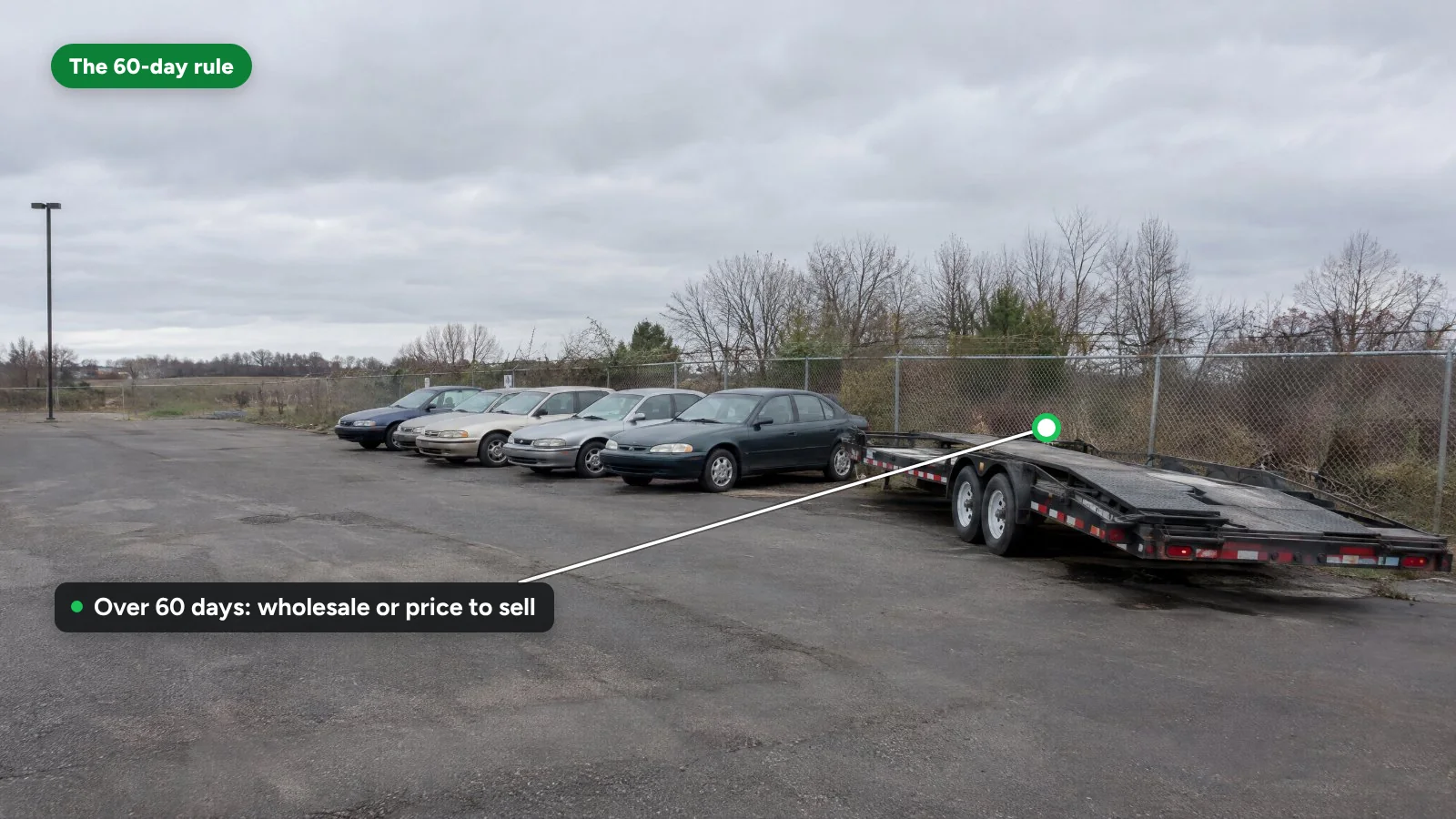
The 60-day rule is a policy that any used car not retailed within 60 days is wholesaled, or priced to sell immediately, so the money goes back into fresher stock. Some stores use 45 days. In a 2022 article, vAuto founder Dale Pollak wrote that market conditions were leading dealers back to policies that call for "immediate wholesaling of vehicles that reach 45 or 60 days in inventory."
The same article argues that one limit for every car amounts to "a blunt management instrument." Pollak writes, "I no longer believe that the same age policy should apply to every car." The practical reading: keep an outer limit, but set earlier targets for riskier units, such as older or high-mileage cars bought at thin margins.
Age buckets make the rule workable, because each bucket triggers a different action:
| Age bucket | What it means | Typical action |
|---|---|---|
| 0 to 30 days | Fresh | Confirm photos, description and price are live; hold gross |
| 31 to 45 days | Watch | Re-check price against comparables; review views and leads; refresh the lead photo |
| 46 to 60 days | Act | Make a price move; push to the sales team, social and video follow-up; set a wholesale date |
| Over 60 days | Exit | Wholesale or price to sell now; record the loss and the reason |
How do you run a weekly aging review?
Run it at the same time each week, with the used car manager, a sales manager and whoever owns merchandising:
- Pull the aging report. Sort it by days in stock, oldest first.
- Check merchandising on every car over 30 days. Real photos, complete description, correct price, live on every listing site.
- Compare price with current comparables. Do it for each car over 30 days.
- Read shopper activity per car. Views but no leads usually points to price or presentation. No views points to visibility.
- Assign one action and one owner. Every car over 45 days gets both.
- Set wholesale dates. Book cars approaching 60 days with your auction or wholesale buyer.
- Record last week's sales by age bucket. This keeps your gross by age data current.
- Check the pipeline. List cars still in recon or waiting for photos, with the days each has already used.
How do inventory platforms, the DMS and merchandising tools divide the work?
Most stores use three kinds of software for inventory. Overlap varies by product, so confirm what yours does.
| Job | Inventory management platform | DMS | Merchandising tools |
|---|---|---|---|
| Appraisal and acquisition | Market data for appraisals and sourcing | Records the purchase and cost | None |
| Pricing | Comparable listings and price guidance | Stores the price | Shows price and price-drop flags on images |
| Reconditioning | Recon tracking in some platforms | Repair orders and recon cost | None |
| Aging | Aging reports and alerts | Days in stock from the stock-in date | Refreshed lead images for older units |
| Listing | Descriptions and syndication in some platforms | Feeds vehicle data | Photos, 360 spins, video and overlays |
| Sale and exit | Wholesale guidance | Deal record and sold status | Removes overlays and listings at sale |
How does merchandising speed affect inventory age?
Every day a car waits for photos counts toward its age while it has almost no chance of a lead. Our days to photo guide measures that gap. Once the car is live, merchandising quality matters just as much.
HelloRamp Studio shortens the gap with a five-minute guided phone walkaround, with no booth or dedicated photographer. Overlay rules add a new-arrival banner and a red price-drop flag, and remove all overlays when a car is marked sold. Its interactive gallery shows which units shoppers looked at and for how long, which feeds step 4 of the weekly review. A trained HelloTrust reviewer checks every image before it publishes.
For cars in the 46 to 60 day bucket, HelloRamp Social puts them in front of shoppers on your social channels, and HelloRamp Engage lets reps send a personalized video to shoppers who already showed interest. Dealerships across the US, Canada and India use HelloRamp.ai to get cars online sooner.
Sources
- Cox Automotive: Used-vehicle inventory builds as September sales pace slows (2026)
- Cox Automotive: Manheim Used Vehicle Value Index declines in September (Q3 2026 press release) (2026)
- Cox Automotive: October 2026 Mid-Month Market Insights (2026)
- vAuto: A time to rethink how you manage inventory age (August 12, 2022, updated August 11, 2025)
Frequently asked questions
How do you calculate inventory turn for a used car dealership?
Multiply monthly retail sales by 12, then divide by the average number of used units in stock. For example, 60 sales a month with 90 units in stock is 8 turns a year. Divide 365 by the turn rate to get approximate days to sell, here about 46.
What is the difference between days' supply and average age?
Days' supply estimates how long current stock would last at the recent sales pace, so it looks forward. Average age measures how long current units have already been in stock, so it looks back. A store can show a healthy days' supply while still carrying a group of old, low-gross cars.
What is the 60-day rule for used cars?
It is a dealership policy that a used car not retailed within 60 days is wholesaled or priced to sell immediately, freeing cash for fresher stock. Some stores use 45 days. Many now pair an outer limit with earlier targets for riskier units, rather than one age for every car.
What are inventory age buckets at a car dealership?
Age buckets group used units by days in stock, commonly 0 to 30, 31 to 45, 46 to 60 and over 60. Each bucket triggers an action, such as checking merchandising, moving price or setting a wholesale date. Tracking gross by bucket shows where profit starts to fall.
How often should a used car manager review aged inventory?
Weekly is a common minimum, at a fixed time, with the used car manager, a sales manager and the person who owns merchandising. Review every car over 30 days, assign an action and owner to each car over 45 days, and set wholesale dates for cars nearing 60.
HelloRamp.ai is AI visual merchandising for car dealerships: guided capture, daily social publishing and personalised video replies to leads, in one platform. Book a walkthrough using your own vehicles.