
Dealership Marketing Software: What's Included, What It Costs and When One App Is Enough
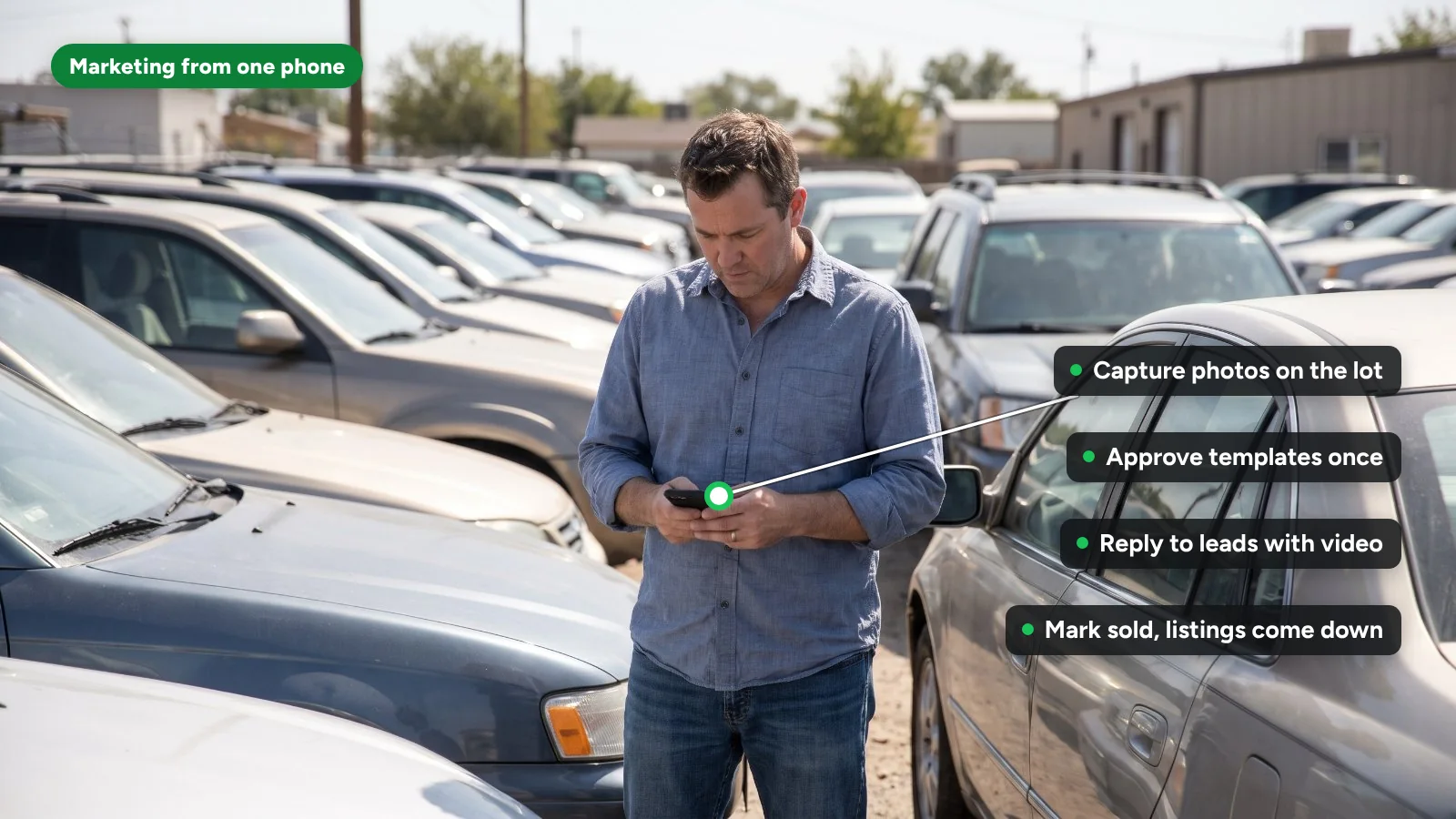
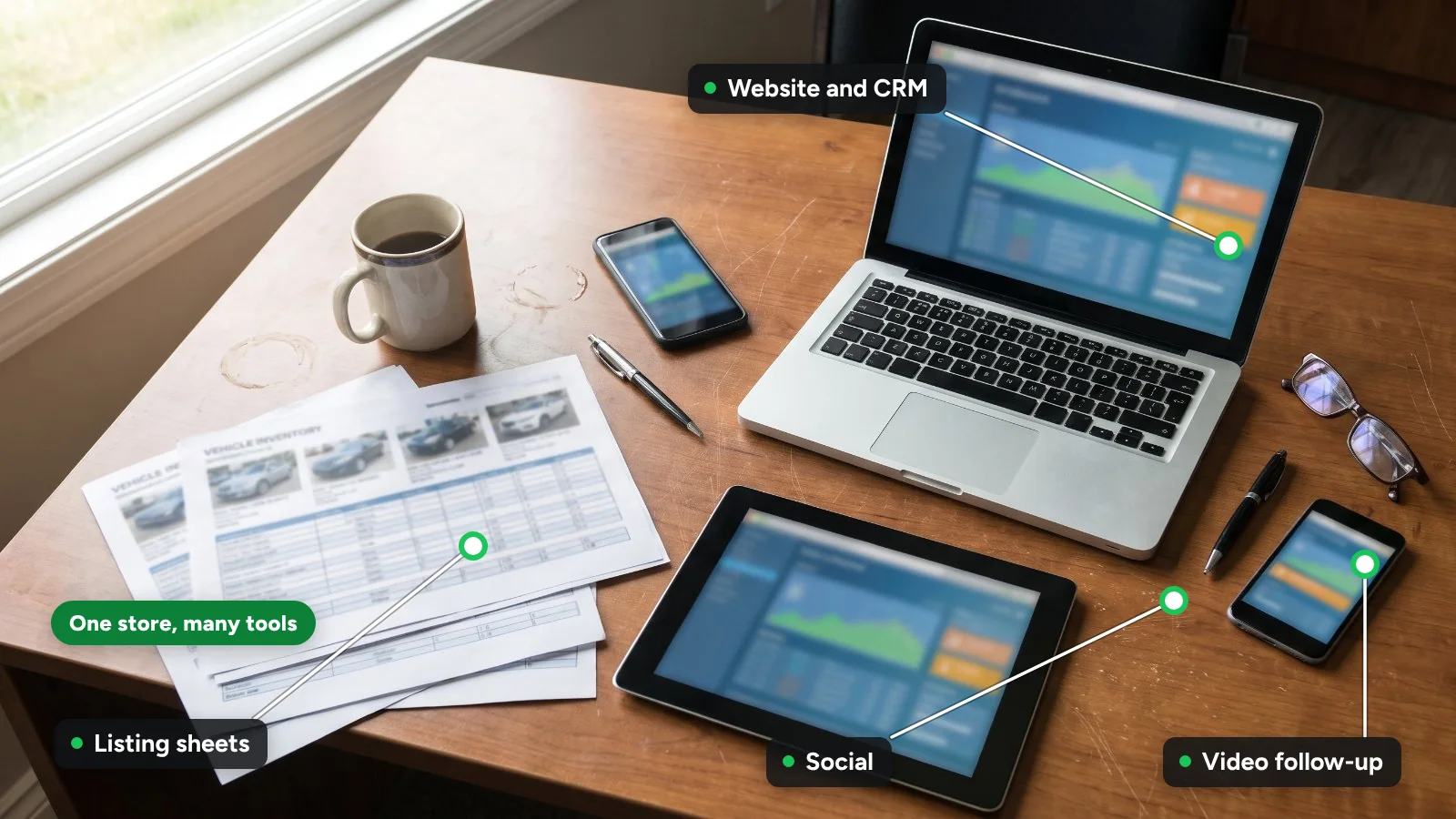
Dealership marketing software is the set of tools a store uses to put its inventory in front of shoppers and turn their interest into appointments: a website with vehicle detail pages, listing syndication, photo and video merchandising, social publishing, video follow-up, a CRM and review management, all fed by the DMS.
Most stores buy these from several vendors, each priced differently (per rooftop, per car, per seat or per lead). That is why the total cost is hard to see and the work feels fragmented. One app is enough for the jobs that share the same input, the vehicle and its media, as long as it connects to your DMS and CRM. It is not enough for jobs that need deep specialist software, such as structuring deals or running the service drive.
What's included in dealership marketing software?
A typical used-car store runs some version of these eight categories:
| Category | What it does | Usually run by | Our explainer |
|---|---|---|---|
| Website and VDP platform | Hosts the site, vehicle detail pages, lead forms, finance and trade tools | GM or marketing | VDP meaning |
| Listing syndication | Sends inventory, prices and photos to listing sites and ad feeds | Used car manager | Where to publish car listings |
| Merchandising and photo | Capture, editing, backgrounds, 360 spins, video tours, overlays | Lot staff or photographer | Vehicle merchandising |
| Social publishing | Posts inventory and brand content to social channels | Marketing | Social media automation |
| Video follow-up | Sends personal or avatar videos to leads by text, email or DM | Sales reps, BDC | Personalized video |
| CRM | Stores leads, tasks and conversations; routes leads to reps | Sales, BDC | Automotive CRM |
| DMS | System of record for inventory, deals and accounting | Office, managers | Dealer management system |
| Reputation and reviews | Requests, monitors and answers customer reviews | GM or marketing | None yet |
The listing and website rows carry the most shopper traffic. In the Cox Automotive 2025 Car Buyer Journey study, 75% of buyers visited third-party websites, 59% visited dealership sites and 26% used social media, with an average of 4.6 sites visited.
What software do successful independent dealerships use?
We are not aware of a public study that lists the software stacks of top-performing independent stores, so treat any "what the best stores use" list with caution. Independents are a large market: NIADA reports they sold 9.8 million vehicles in 2025, out of an estimated 38.6 million total used sales.
The pattern that holds up in practice is fewer tools, run well. A DMS and CRM come first (sometimes in one product), then a website and listing feeds, then one merchandising tool. Social and video follow-up come next, once those basics run without daily fixes.
Why does dealership marketing feel so fragmented across tools?
Because each category was sold separately, and each keeps its own copy of the vehicle and the lead. The symptoms are familiar:
- Double entry. The same car is edited in the website, the listing tool and the social scheduler, and the three versions drift apart.
- Sold cars still advertised. When sold status does not flow from the DMS to every tool, ads and posts keep running for cars that are gone. Our DMS guide explains why that sync matters.
- Media made three times. Photos for listings, separate graphics for social and separate videos for follow-up, each shot or edited by someone different.
- Separate logins and reports. Each tool counts its own leads, so the numbers rarely agree.
How is dealership marketing software priced?
We have not found a neutral, current survey of dealership software prices by category, so this guide does not quote market ranges. What you can compare is the pricing model:
| Model | How it is billed | What to check |
|---|---|---|
| Per rooftop | Flat monthly fee per location | Tiers by lot size; add-on modules |
| Per car | Per vehicle in stock or uploaded per month | Whether carried-over cars count again; overage rates |
| Per seat | Per rep or login | Paying for inactive users |
| Per lead or per sale | Fee per lead delivered or car sold | Lead definitions and duplicates |
| Setup and integration | One-time or monthly | DMS access fees, onboarding, data migration |
How much does a full dealership marketing stack cost per car?
Use one formula: stack cost per car sold = total monthly software fees ÷ retail units sold that month.
Example (illustrative inputs, not market prices): a used-car store retails 40 cars a month, uploads 50 cars and has four sales reps.
| Category | Example monthly fee | Basis |
|---|---|---|
| Website and VDP platform | $1,200 | Per rooftop |
| Listing syndication | $300 | Per rooftop |
| Merchandising and photo | $500 | 50 cars × $10 |
| Social publishing | $250 | Per rooftop |
| Video follow-up | $200 | 4 seats × $50 |
| CRM | $800 | Per rooftop |
| Reputation | $300 | Per rooftop |
| Total | $3,550 |
What contract terms should you check before you sign?
Month-to-month pricing is easier to leave, so annual terms usually come with a discount. Either way, read for these:
- Term and renewal. The notice window for cancelling before an auto-renewal date.
- Early termination. Whether you owe a fee or the remaining months.
- Price changes. Annual increases and what moves you into a higher tier.
- DMS integration. Who pays any DMS access fee, how often inventory syncs and whether sold status flows back.
- Data and media ownership. Whether you can export leads, photos and videos in standard formats when you leave.
- Seats and rooftops. The cost of adding a rep or a store mid-term.
Can one app handle photos, social media and follow-up?
Yes, for those three jobs, because they share an input: the vehicle record and its photos and video. One app can capture the car once, publish the listing images, build the social posts and use the same media in a follow-up video, with one sold-status trigger stopping all three.
Consolidating makes sense when one or two people run marketing, when the same media should appear everywhere and when separate tools keep advertising sold cars. Best-of-breed is the better choice when you need specialist depth, such as complex BDC routing in the CRM, or when your current tools already integrate cleanly and switching would cost more than it saves. One vendor for everything also concentrates risk if that vendor has an outage.
A simple test: list each marketing job, who does it and how many times the same car is entered. Re-entry is the cost of fragmentation. If you are weighing people as well as software, see our comparison of a car dealership marketing agency vs in-house vs software.
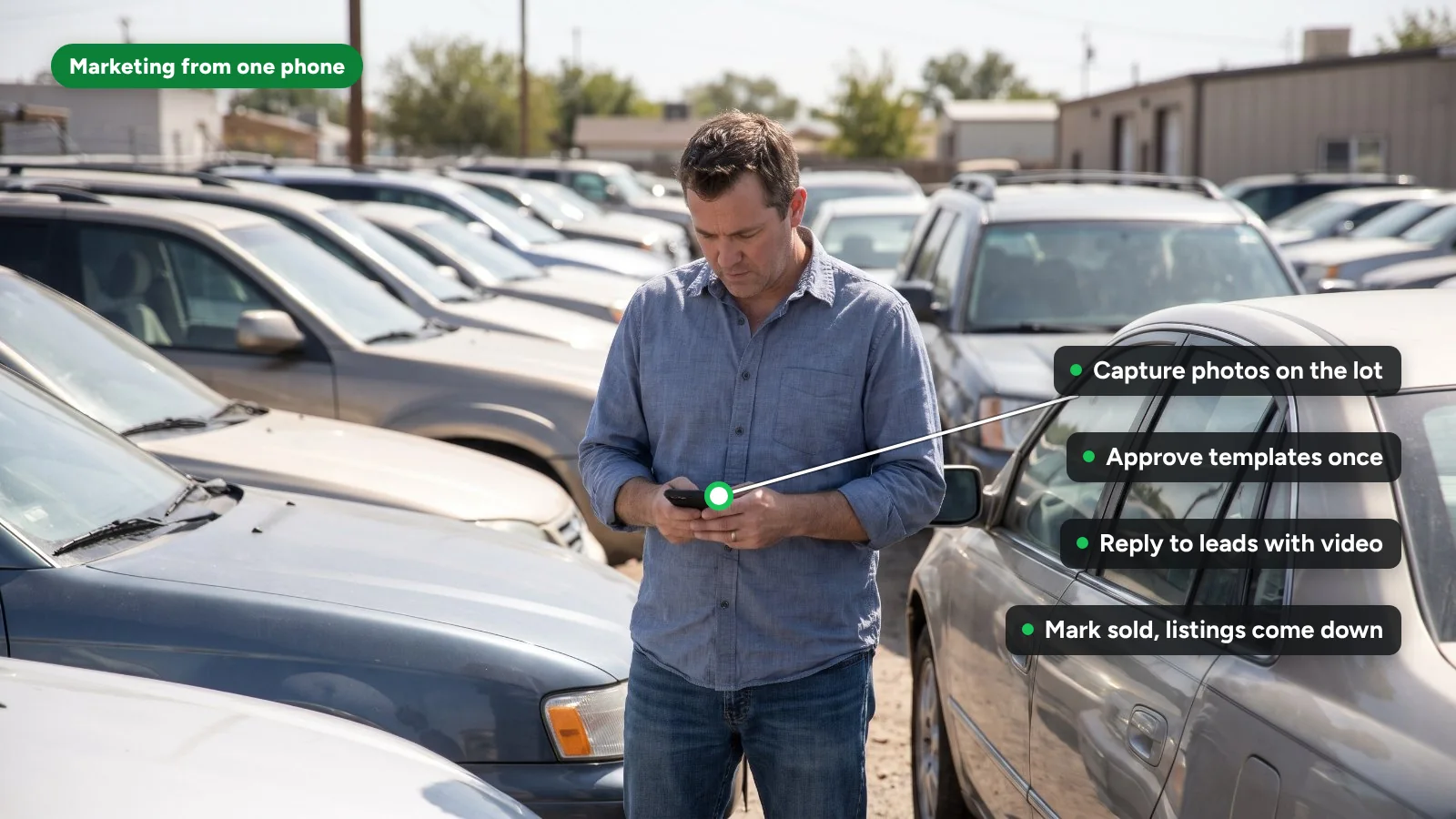
Can you run dealership marketing from a smartphone?
Increasingly, yes. Ask each vendor to demo these on a phone, not a desktop:
- Capture. Guided photos and video taken on the lot, without a booth.
- Approval. Templates and posting cadence set once, without per-post sign-off.
- Follow-up. Lead alerts and a video reply sent within a minute or two.
- Status. Marking a car sold and seeing listings and posts come down.
Where does HelloRamp.ai fit?
HelloRamp.ai puts three products on one content engine, so a car is captured once and published everywhere. HelloRamp Studio produces listing photos from a guided phone walkaround, plus 360 spins and video tours on the Pro and Ultra plans. HelloRamp Social publishes per-car posts, reels and Facebook Marketplace listings daily on five channels, and listings come down when a car sells. HelloRamp Engage sends video replies to leads and alerts the rep when one is opened. HelloRamp.ai syncs with your DMS and CRM rather than replacing them, and serves single-rooftop and multi-rooftop dealerships across the US, Canada and India, with Europe and Australia next.
Pricing is per car uploaded per month, not lot size, and a car carried over from a previous month does not count again. At up to 50 cars a month, Standard is $279 and Pro is $449 per month, as listed on the HelloRamp.ai pricing page in November 2026. Ultra adds an AI video a month for every car in its band and unlimited Engage reps. Social is included in Pro and Ultra. Billing is monthly or yearly, DMS integration and onboarding are included on all plans, and the free trial needs no card or contract. Example: Pro at 50 cars works out to $8.98 per car uploaded ($449 ÷ 50).
Sources
- Cox Automotive: 2025 Car Buyer Journey Study summary (2026)
- NIADA: NIADA's UCIR shows independent used sales top 9.8 million in 2025 (2026)
- Cox Automotive: Power of Data study reveals most dealers still experience data challenges (July 30, 2024)
- NADA: NADA Data 2025, Annual Financial Profile of America's Franchised New-Car Dealerships (2026)
Frequently asked questions
What is the difference between dealership marketing software and a DMS?
A DMS is the store's system of record for inventory, deals and accounting. Marketing software uses that data to advertise cars and respond to shoppers through websites, listings, photos, social posts, video and the CRM. Marketing tools work best when they read inventory and sold status from the DMS automatically.
How do you calculate dealership marketing software cost per car sold?
Add up every monthly software fee for marketing tools, then divide by the retail units sold that month. For example, $3,550 in fees and 40 cars sold is $88.75 per car. Leave out advertising spend and track it separately, so each number stays clear.
Is per-car pricing better than a flat monthly fee for dealership software?
Per-car pricing follows your volume, so cost per car sold stays steadier in slow months. A flat fee can be cheaper per car in busy months but costs more per car when sales drop. Check whether a per-car plan counts cars carried over from the previous month.
What should a dealership check before signing a marketing software contract?
Check the term length, the auto-renewal notice window and any early termination fee. Ask who pays DMS integration fees, how often inventory syncs, whether sold status flows back, and whether you can export your leads, photos and videos in standard formats if you leave.
Can a small used car dealership run its marketing from a phone?
Many tasks can now be done from a phone: guided vehicle photos, approving social templates, receiving lead alerts and sending video replies. Ask vendors to demonstrate each task on a phone during the demo, including marking a car sold and confirming its listings and posts come down.
HelloRamp.ai is AI visual merchandising for car dealerships: guided capture, daily social publishing and personalised video replies to leads, in one platform. Book a walkthrough using your own vehicles.