
Car Dealership Marketing Plan: A One-Page Template for Used-Car Stores

A car dealership marketing plan is a one-page document that sets a monthly sales goal, the leads it takes, a budget per car sold, the order to set up channels, and the numbers to check every month. For a used-car store without a marketing team, it should run on about five hours of work a week.
This guide builds that page step by step and ends with a template you can copy.

How many leads do you need to hit your sales goal?
Start with retail units, not impressions or followers. Then split the goal by source: how many sales come from online leads, and how many from walk-ins, repeat buyers and referrals. Your CRM or deal log shows the split for the last six months.
Next, turn the online share into a lead target using a lead-to-sale rate. A Foureyes study of about 700 US dealerships (data from the second half of 2023, published February 2024) measured used-vehicle internet leads at a 41% appointment set rate, a 50% show rate and a 40% close rate on shown appointments. Multiplied together, that is about 8.2% of leads becoming sales. Maritz notes that dealers commonly hear they "should be closing at 10% to 15%" of internet leads.
Example: a store wants 30 retail units a month, with 20 coming from online leads.
- At 8.2%: 20 ÷ 0.082 = about 244 leads a month
- At 10% to 15%: 20 ÷ 0.15 = about 133 leads, and 20 ÷ 0.10 = 200 leads a month
How much should you spend per car sold?
The most useful way to set a used car dealership marketing budget is per unit sold. It ties spending to the number that pays for it. The method has three parts.
- Pick a ceiling from your own gross. Look at average front-end gross per retail unit in your deal log and decide what share you will spend to sell a car.
- Multiply by the unit goal. That is the monthly budget.
- Track the actual cost per car sold. Add every marketing cost for the month (marketplace listing packages, website, ads, photo and social software, and any freelancer), then divide by retail units sold.
Which marketing channels should you set up first?
Set up channels in the order buyers look. In Cox Automotive's 2025 Car Buyer Journey study (released January 2026), used-vehicle buyers visited third-party sites (77%), dealership sites (60%), search engines (41%) and social media (26%) while shopping.
- Google Business Profile and reviews. Keep hours, photos and phone number correct, and ask every buyer for a review. Google stopped showing free vehicle listings in Business Profile and organic Search in late 2025, so the profile now works for trust and directions, not inventory.
- Website VDP quality. Every vehicle detail page needs a full photo set, a price, specs and a working inquiry form. The SEO guide for car dealers covers search visibility.
- Marketplace listings. Syndicate every unit with the same photos and price.
- Social from inventory. Post new arrivals and price changes. Content mix and cadence are in the car dealership social media marketing guide.
- Follow-up process. Write a rule for who replies to each lead, how fast and how many times.
- Paid ads last. Ads send more traffic to the pages above, so fix those pages first. When you start, Google vehicle ads are a common first test. Google describes them as a "lower funnel ad format" that supports new and used inventory and runs through Performance Max. Set a fixed monthly cap and judge it on cost per car sold, not clicks.
What goes on the one-page marketing plan?
Copy this table and fill in the right column.
| Plan item | What to write | Example (30-unit store) |
|---|---|---|
| Monthly retail unit goal | Total used retail units | 30 |
| Units from online leads | Share from your deal log | 20 |
| Lead-to-sale rate | Benchmark now, own rate after 90 days | 8.2% to 15% |
| Leads needed per month | Online units ÷ lead-to-sale rate | 133 to 244 |
| Cost per car sold ceiling | Share of average front-end gross | $200 |
| Monthly budget | Ceiling × unit goal | $6,000 |
| Channels live | In setup order | Profile, VDPs, marketplaces, social |
| Lead response standard | Who replies, how fast | Owner or rep, within 15 minutes in open hours |
| Weekly hours | Time blocked on the calendar | About 5 (4 weekly, plus monthly tasks) |
| Review goal | New reviews per month | 15 |
| Monthly review date | Fixed day | First Monday |
How much time does the plan take each week?
The hours below are a typical example for a store selling about 30 cars a month. They assume guided phone capture and scheduled social posting.
| Task | When | Hours |
|---|---|---|
| Capture photos, spin and video of new arrivals | Daily as cars are front-line ready | 1.0 a week |
| Check listing prices match the DMS; remove sold units | Monday and Thursday | 0.5 a week |
| Approve inventory posts and reply to comments | Weekly | 1.0 a week |
| Reply to reviews; update Business Profile photos | Weekly | 0.5 a week |
| Audit lead follow-up in the CRM | Friday | 1.0 a week |
| Pull numbers and cost per car sold | Monthly | 1.5 a month |
| Refresh media and pricing on units over 45 days | Monthly | 1.0 a month |
| Adjust ad budgets and plan next month | Monthly | 1.5 a month |
Where does HelloRamp.ai fit? Several rows above can run with less manual work. HelloRamp Studio handles guided capture, backgrounds and 360° spins. HelloRamp Social turns every car into posts and Facebook Marketplace listings, publishes them every day and takes listings down when the car sells. HelloRamp Engage sends personalized video replies to leads. The HelloRamp.ai Dealership plan is $499 a month in the US for up to 100 cars, and the Social add-on for that plan is $399 a month (as listed on the pricing page in October 2026).
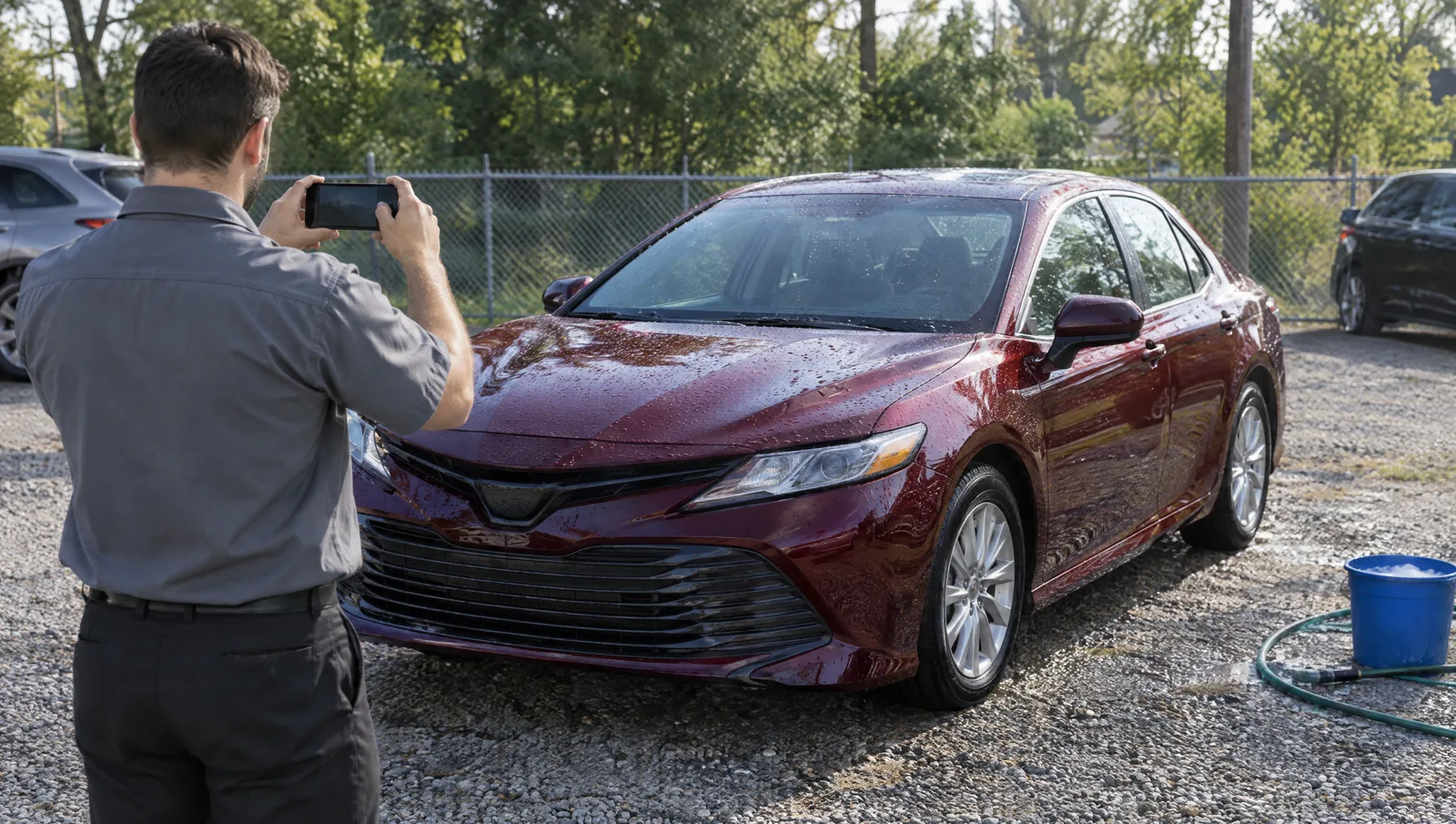
What are 10 low-cost car dealership marketing ideas?
- Ask at delivery. Put a review request card with a QR code on the dash of every delivered car.
- Film new arrivals. Post a 30-second walkaround of each car within one day of it being front-line ready.
- Refresh aging units. Give cars that pass 30 days a new lead photo and repost them as a fresh listing.
- Mine past buyers. Email them at 12 and 36 months with a trade-in appraisal offer.
- Use Facebook Marketplace fully. List every unit with the full photo set, not three phone shots.
- Answer the top five questions on video. Cover financing, warranty, trade-ins, delivery and inspections, and pin the clips on your profiles.
- Build a referral loop. Set up a referral payment with local independent repair shops for customers they send.
- Open the lot. Host a cars-and-coffee morning once a quarter.
- Reply with the real car. Answer web leads with a short video of the actual vehicle instead of a text-only template.
- Show one total price everywhere. In the US, the FTC's September 2026 price transparency FAQs say an advertised price "must be the actual price that any consumer can walk in and pay," other than government charges, and cover pricing across different media. Canada and other markets set their own rules. This is general information, not legal advice; check with your compliance counsel.
What should you measure every month?
- Retail units sold, by lead source
- Leads by source, and cost per lead by source
- Cost per car sold, total and by source
- Appointment set, show and close rates on internet leads
- Median time to first response
- Days from arrival to live online listing
- VDP views per unit, and units with no views in 14 days
- Units over 45 days in stock (for context, US used days' supply, a different measure from unit age, was 44 days in August 2026)
- New reviews and average rating
Sources
- Foureyes: Dealership data study on appointment set, show and close rates (February 2024)
- Maritz: Dealership internet sales metric FAQ (October 2025)
- Cox Automotive: 2025 Car Buyer Journey Study summary (January 2026)
- Google for Developers: Manage vehicle listings in Business Profile (current)
- Google Merchant Center Help: About vehicle ads (current)
- Kelley Blue Book: Pricing guidelines for dealers (effective July 2020)
- FTC: FTC publishes price transparency FAQs for auto dealers (September 2026)
- Cox Automotive: Used vehicle inventory, August 2026 (September 2026)
Frequently asked questions
How much should a used car dealership spend on marketing each month?
Set the budget per car sold, not as a round number. Pick a ceiling you can afford from your own average front-end gross per unit and multiply it by your monthly unit goal. Then track actual spend divided by retail units sold and adjust each month.
What should a new used car dealership set up first for marketing?
Start with an accurate Google Business Profile and a review request routine. Then make sure every vehicle detail page has full photos, a price and a working inquiry form. Add marketplace listings next, then inventory-based social posts and a written follow-up process. Leave paid ads until those work.
How many leads does a used car dealership need to sell 30 cars a month?
It depends on how many sales come from online leads and on your lead-to-sale rate. If 20 of the 30 sales come from internet leads and about 8% to 15% of leads buy, the store needs roughly 133 to 244 internet leads a month.
How many hours a week does dealership marketing take for one person?
A single-rooftop used store selling about 30 cars a month can run a basic plan in about four hours a week. Add about four hours once a month for reporting and planning. That assumes guided phone photography and scheduled social posting rather than manual photo editing.
How often should a dealership update its marketing plan?
Review the numbers monthly and change tactics when a channel's cost per car sold rises or its leads fall. Rewrite the goals and budget each quarter, or sooner if inventory levels, staffing or average gross per unit change enough to move the cost ceiling.
HelloRamp Studio guides the walkaround, corrects the lighting and backgrounds, and produces the listing stills, the 360° spin and the video tour from one five-minute capture on a phone. No booth, rig or dedicated photographer.