
Social Media Automation for Car Dealerships: General Schedulers vs Inventory-Aware Tools
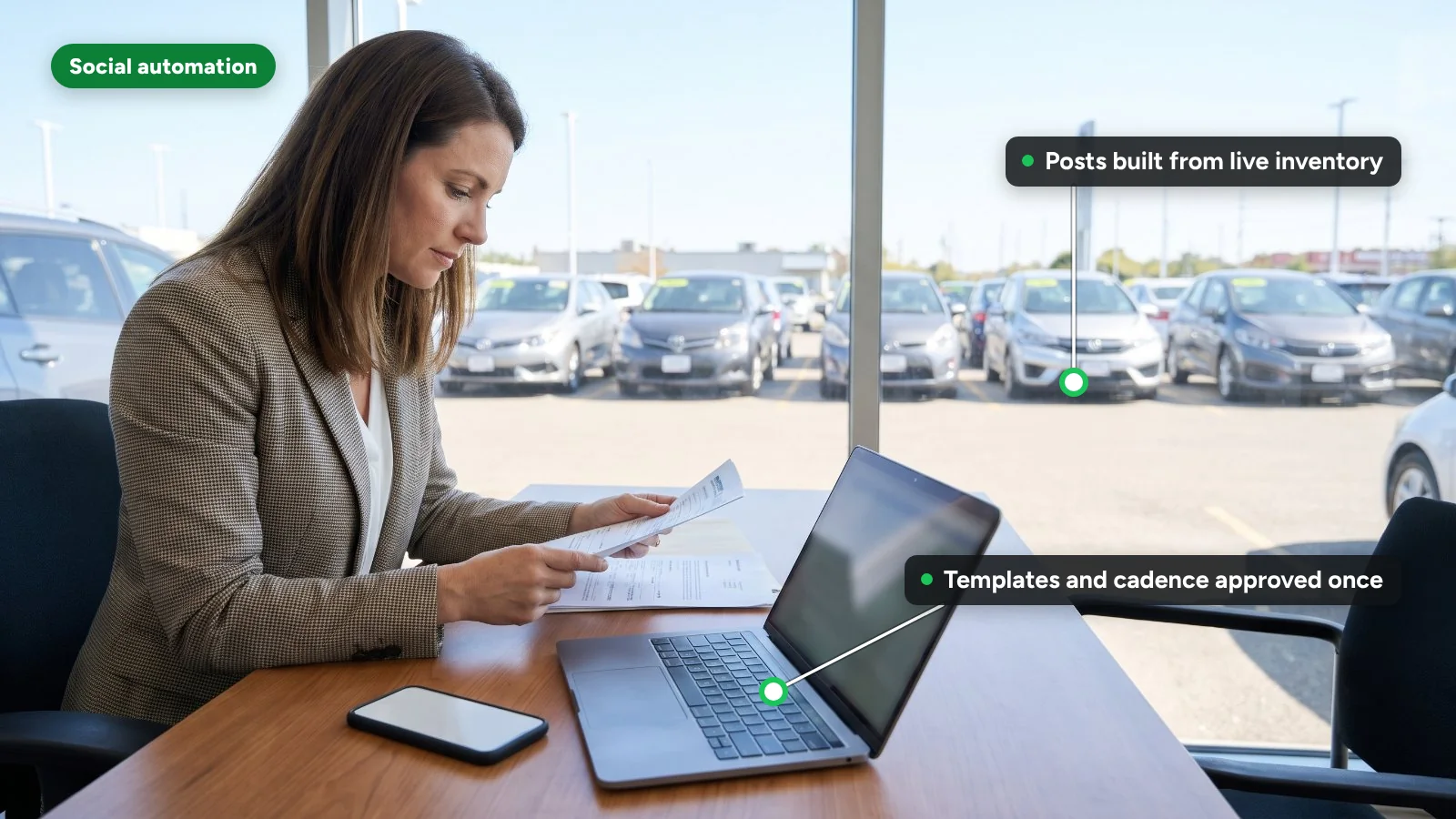
Social media automation for car dealers comes in three kinds: general schedulers that publish posts a person has already made, design apps that build those posts faster, and inventory-aware tools that create, publish and remove a post for each car from your inventory. Pick by how many cars you add a month and the staff time each car can get.
Schedulers automate the posting and design apps automate the layout. Only inventory-aware tools automate the work in between: turning a listing into content and taking it down when the car sells. Which posts to automate at all is covered in our car dealership social media marketing guide. This article compares the tools.
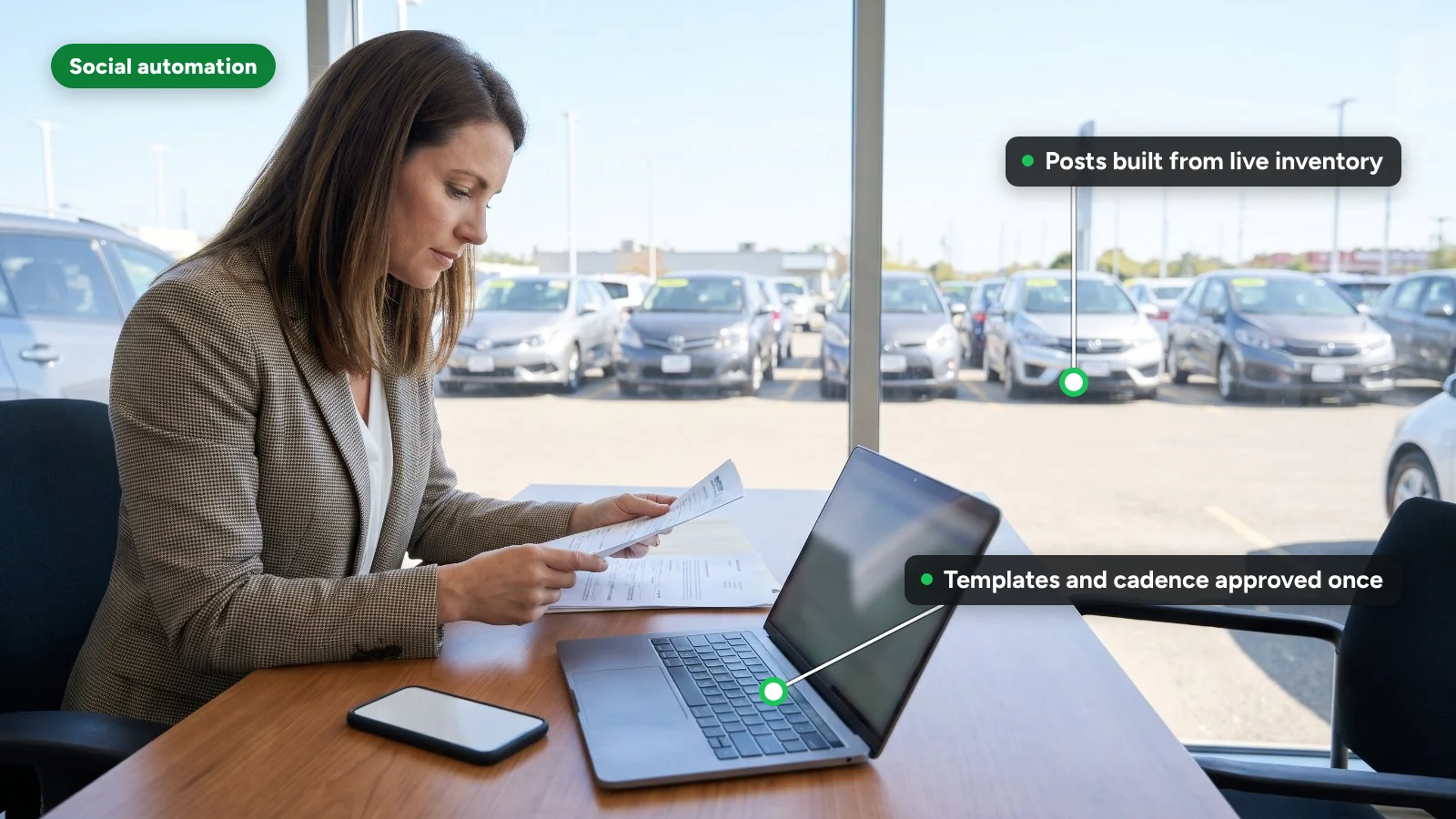
What are the three types of social media automation for car dealers?
- General schedulers. Hootsuite, Buffer and Meta Business Suite are well-known examples. They publish a calendar of posts and gather comments and analytics in one place. Pricing models differ: Hootsuite charges per user, with paid plans starting at $99 per user per month billed annually; Buffer charges per connected channel, from $5 per channel per month billed annually; and Meta Business Suite is a free app for scheduling posts and stories on a Facebook Page and Instagram account (as listed in November 2026). Someone still makes every post.
- Design apps. Canva is the common example. Templates keep posts on brand, and its Bulk Create feature links spreadsheet columns to placeholders so each row produces one design. That helps with inventory, with one catch: Canva says images must be embedded in the sheet, one per cell, and image URLs from cloud photo storage are treated as plain text. Photo links in an inventory export may not fill in on their own.
- Inventory-aware tools. These connect to your DMS or inventory feed, read each vehicle record (year, model, mileage, price, photos, status) and generate posts and short videos per car. When a price changes or a car sells, the post changes or comes down.
How do schedulers, design apps and inventory-aware tools compare?
| General scheduler | Design app | Inventory-aware tool | |
|---|---|---|---|
| Staff work per car | Pull photos, write caption, build post, schedule each channel | Export data and photos, run the template, then schedule elsewhere | Approve templates and rules once, then spot-check |
| Sold-car removal | Manual, post by post | Manual, in whichever scheduler published it | Automatic when status changes in the feed |
| Per-platform formatting | Manual crops, or one size for all | Resized per format by hand | Feed, reel and listing formats made per car |
| Video and reels | Publishes video you supply | Template video, built by hand | Generated per car from photos or capture |
| Brand consistency | Depends on whoever builds the post | Strong if templates are locked | Locked templates applied to every car |
| Cost model | Per user or per channel | Subscription | Varies: per car, per rooftop or per seat |
| Review step | You review before scheduling | You review before export | Varies by vendor; ask whether a person checks before publishing |
| Best fit | Brand, event and community posts | Promotions and one-off graphics | Daily per-car inventory posts |
So is Hootsuite or an automotive-specific tool better? The difference is who creates the post. A scheduler suits posts a person should write anyway. An inventory-aware tool suits per-car posting once it becomes a daily job nobody has time for. Many stores run both.
Example: a store adds 60 used cars a month and posts each to four channels. With a scheduler, each car takes 4 minutes for photos and caption plus 2 minutes per channel: 4 + (4 × 2) = 12 minutes. 60 × 12 = 720 minutes, or 12 hours a month, before price drops and sold-car removals. Use your own timings.
What does a social tool that understands car inventory need?
Automation is only as good as what it reads. Check six things first:
- A clean inventory feed or DMS connection. Every post is built from the vehicle record, so a wrong trim or stale price goes public on every channel. Audit 10 records first.
- Good photos. Automation repeats whatever is in the feed. For banners and price flags on photos, see our guide to dealer photo overlays.
- Sold-status sync. Ask how long it takes from "sold" in your DMS to the post coming down. The FTC's March 2026 warning letters to 97 dealership groups listed advertising unavailable vehicles among illegal practices, and said advertised prices must include all mandatory fees.
- Templates with locked disclaimers. Price disclaimers belong in the template, not typed per post. Some states set extra rules: California bars dealers from advertising a specific vehicle without identifying it by model, model year and either its license number or the distinguishing part of its VIN (Cal. Veh. Code § 11713.1). This is general information, not legal advice. Check your templates with your compliance counsel.
- A human review step. Approve each post, approve templates once, or sample output weekly.
- Platform compliance. Third-party tools publish through platform APIs. TikTok restricts content posted by unaudited API clients to private viewing, so ask a vendor whether its TikTok integration has passed TikTok's audit. Instagram's publishing API works with professional accounts and caps API-published posts per 24 hours. Instagram's original content guidelines also say accounts that mainly post content they did not create or materially edit may not be recommended to new audiences, so post your own photos and video rather than reposts.
How do dealerships turn listings into social media content?
The workflow is the same whichever tool you use:
- The car is photographed. Content waits on photos.
- The vehicle record is complete. Trim, mileage, price and key equipment are in the DMS.
- An event triggers a template. New arrival, price drop or feature spotlight, each with one approved template.
- The caption is assembled. Year, make, model, trim, mileage, two features, price with disclaimer and a tagged link to the VDP.
- Formats are produced per platform. A feed image or carousel, a vertical 9:16 reel and, where you use it, a Marketplace listing. For filming short video yourself, see our TikTok, Reels and Shorts playbook.
- Someone reviews it. Then it publishes on schedule.
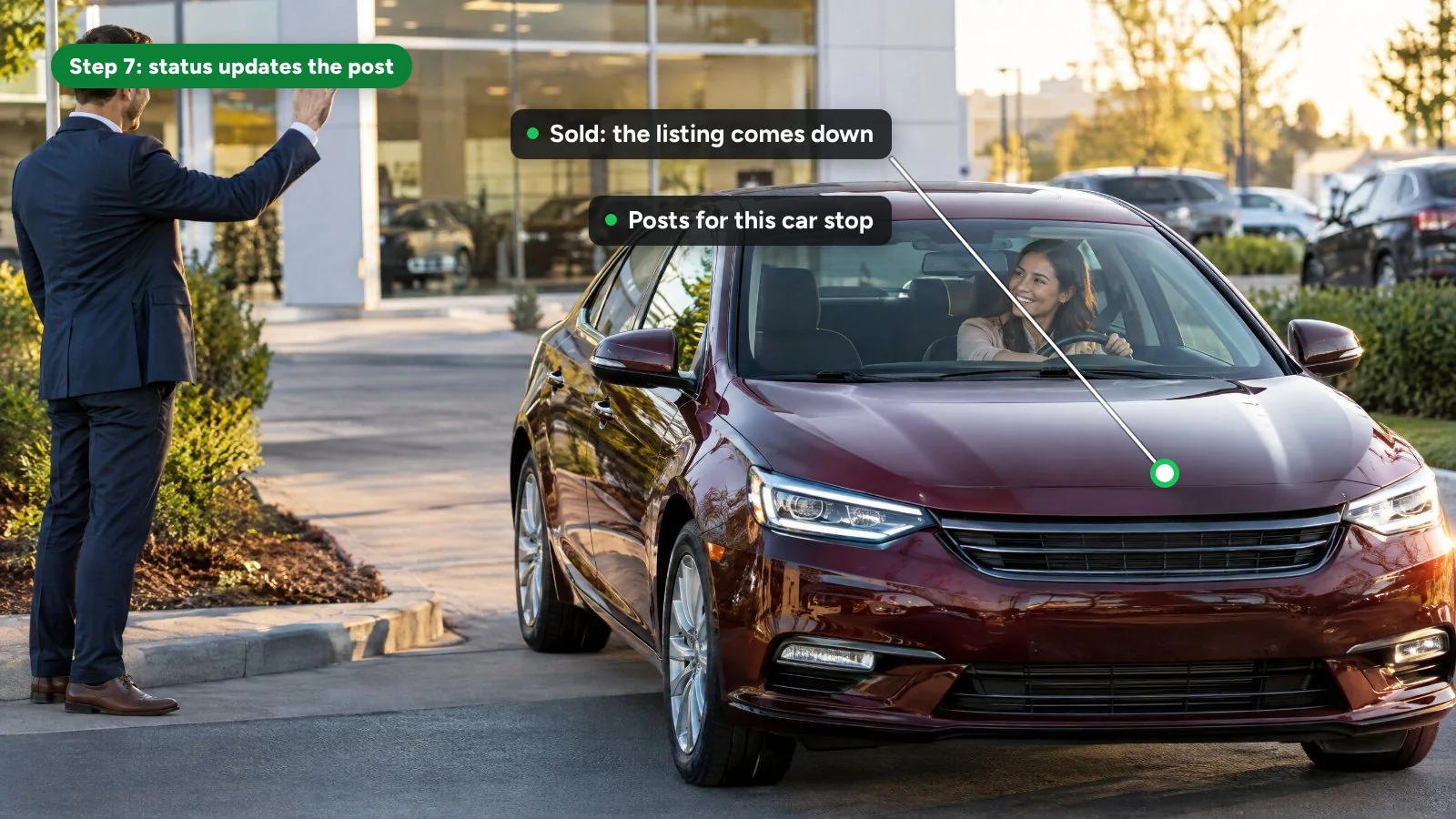
- Status changes update the post. A price drop triggers the price-drop template. A sale removes the listing and stops further posts.
How do dealerships keep social media consistent across platforms?
Three controls:
- A brand kit. Logo, colors, fonts and approved disclaimer text, stored once and locked.
- A small template set. Six to eight templates cover most inventory posts: new arrival, price drop, feature spotlight, walkaround reel, certified pre-owned and, if you use it, just sold.
- A fixed cadence. Schedule inventory posts by event, not by empty calendar slot: new arrivals within a day of photos, price drops the day they change, removals the day a car sells. Add two or three brand or community posts a week, written by a person.
How do you set up dealership social media automation in a week?
| Day | Task |
|---|---|
| 1 | Audit 10 inventory records and their photos; note missing fields and how long sold status takes to update |
| 2 | Build the brand kit and get disclaimer text approved |
| 3 | Create or approve the template set |
| 4 | Connect business or professional accounts on each platform and confirm who has admin access |
| 5 | Test on five cars, then check every post on a phone |
| 6 | Set the cadence, the review owner and UTM tags for links |
| 7 | Go live, mark one car sold as a test and confirm its posts come down |
After 30 days, review posts published, sold-car removals made on time, messages received and leads by source.
What social media work should stay with people?
Automation handles per-car posts. Keep these with people:
- Replies to comments and messages. "Is this still available?" is a lead. Answer it the same day.
- Deliveries and customer stories. Post only with the customer's permission.
- Staff, community and event posts. Per-car posts cannot build local reputation.
- Complaints. Move them to a private conversation with a manager.
How does HelloRamp Social automate inventory posts?
HelloRamp Social is an inventory-aware tool. It publishes branded posts, reels and listings for each vehicle in live inventory, daily, on five channels: Instagram, Facebook, TikTok, YouTube and Facebook Marketplace, with each channel's native format made from one capture. Content comes from the DMS record and the media HelloRamp Studio produces. Logos, colors, fonts and state disclaimers are locked to the brand kit. The dealer approves templates and cadence once, a trained reviewer checks every image before it publishes, and when a car sells its listing comes down and posts stop. Social does not create general brand posts; those stay with your team. Social is included in the HelloRamp.ai Pro and Ultra plans. HelloRamp.ai serves dealerships across the US, Canada and India.
To see posts generated from your own inventory, book a HelloRamp.ai demo.
Sources
- Hootsuite: Plans (November 2026)
- Buffer: Pricing (November 2026)
- Apple App Store: Meta Business Suite (November 2026)
- Canva Help Center: Create designs in bulk (current)
- FTC: FTC warns 97 auto dealership groups about deceptive pricing (March 2026)
- California Legislative Information: Vehicle Code § 11713.1 (current)
- TikTok for Developers: Content Posting API, direct post (updated October 2026)
- Meta for Developers: Instagram Platform content publishing (current)
- Instagram Creators: Original content guidelines (current)
Frequently asked questions
Can Hootsuite or Buffer post car inventory automatically?
They publish posts on a schedule, but they are not built to read a vehicle record. Someone still prepares each car's photos, caption and formats, and removes posts when cars sell, unless you build an integration. Check each tool's current features, since they change often.
Is Meta Business Suite enough for a small used car dealership?
For a store adding a few cars a week, it can be. The app is free and schedules posts and stories on a Facebook Page and Instagram account. It covers those two platforms only, so TikTok and YouTube need another tool, and each car's post is still made by hand.
How quickly should a sold car come off dealership social media?
The same day it sells. Posts for unavailable cars produce calls you cannot convert, and the FTC listed advertising unavailable vehicles among illegal practices in its March 2026 warning letters. Test your tool by marking one car sold and timing how long its posts take to come down.
Do automated inventory posts need price disclaimers?
If a post shows a price, it should carry the same disclaimer as your other ads, and the price should include all mandatory fees. State rules vary, so lock approved disclaimer text into every template. This is general information, not legal advice; check templates with your compliance counsel.
Why might posts from a third-party tool not appear publicly on TikTok?
TikTok restricts content posted through API clients that have not passed its audit to private viewing. If posts from a scheduling or inventory tool are not showing publicly, ask the vendor whether its TikTok integration is audited, and check the account's privacy settings.
HelloRamp.ai is AI visual merchandising for car dealerships: guided capture, daily social publishing and personalised video replies to leads, in one platform. Book a walkthrough using your own vehicles.