
AI Avatar Videos for Car Sales Follow-Up: What They Are, When They Work and What to Disclose
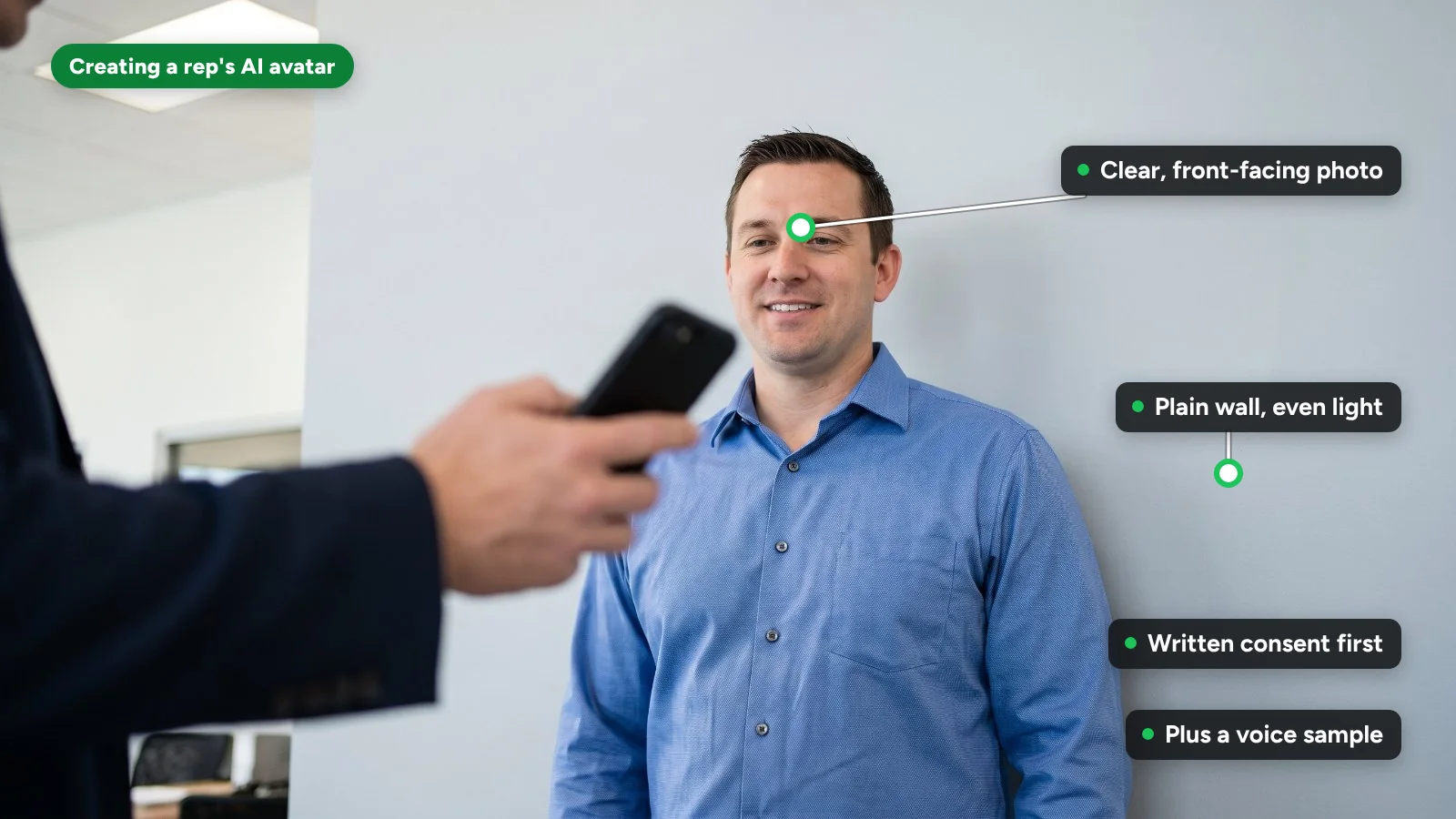
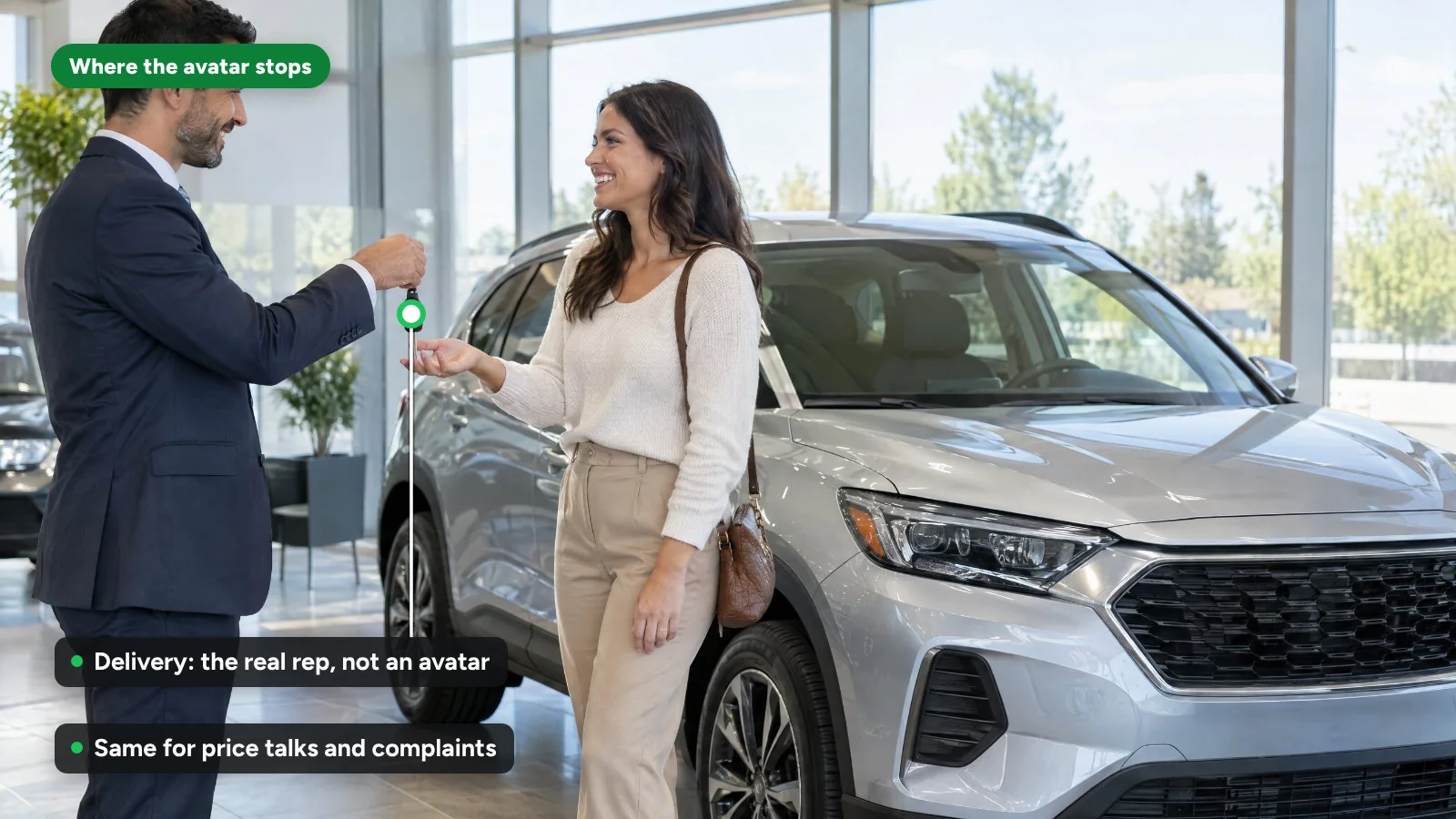
An AI avatar video for sales is a short video in which a digital likeness of a salesperson, built from their photo and voice sample, speaks a script written for one lead over footage of the car they asked about. Avatars suit fast first replies, after-hours leads and routine nudges. The real salesperson takes over for negotiation, problems and delivery.
Disclosure matters. In a Pew Research Center survey of 5,023 US adults in June 2025, 76% said it is extremely or very important to be able to tell whether pictures, videos and text were made by AI or by people. And 53% were not too or not at all confident they could detect the difference. A buyer who later discovers an undisclosed avatar has a reason to doubt the rest of what you said.
What is an AI avatar video, and how is it different from a stock AI presenter?
There are two kinds of avatar, and the difference affects trust and compliance:
- The rep's own avatar (sometimes called a digital twin). Built from the actual salesperson's photo and voice, with their consent. The shopper sees and hears the person they will meet at the store.
- A stock AI persona. A presenter who is not a real person, often used for walkaround and social videos. It can explain a car well, but it is not anyone the buyer can ask for at the showroom.
How is an AI avatar of a salesperson created?
The process is similar across most tools, including general-purpose avatar platforms such as HeyGen and Synthesia:
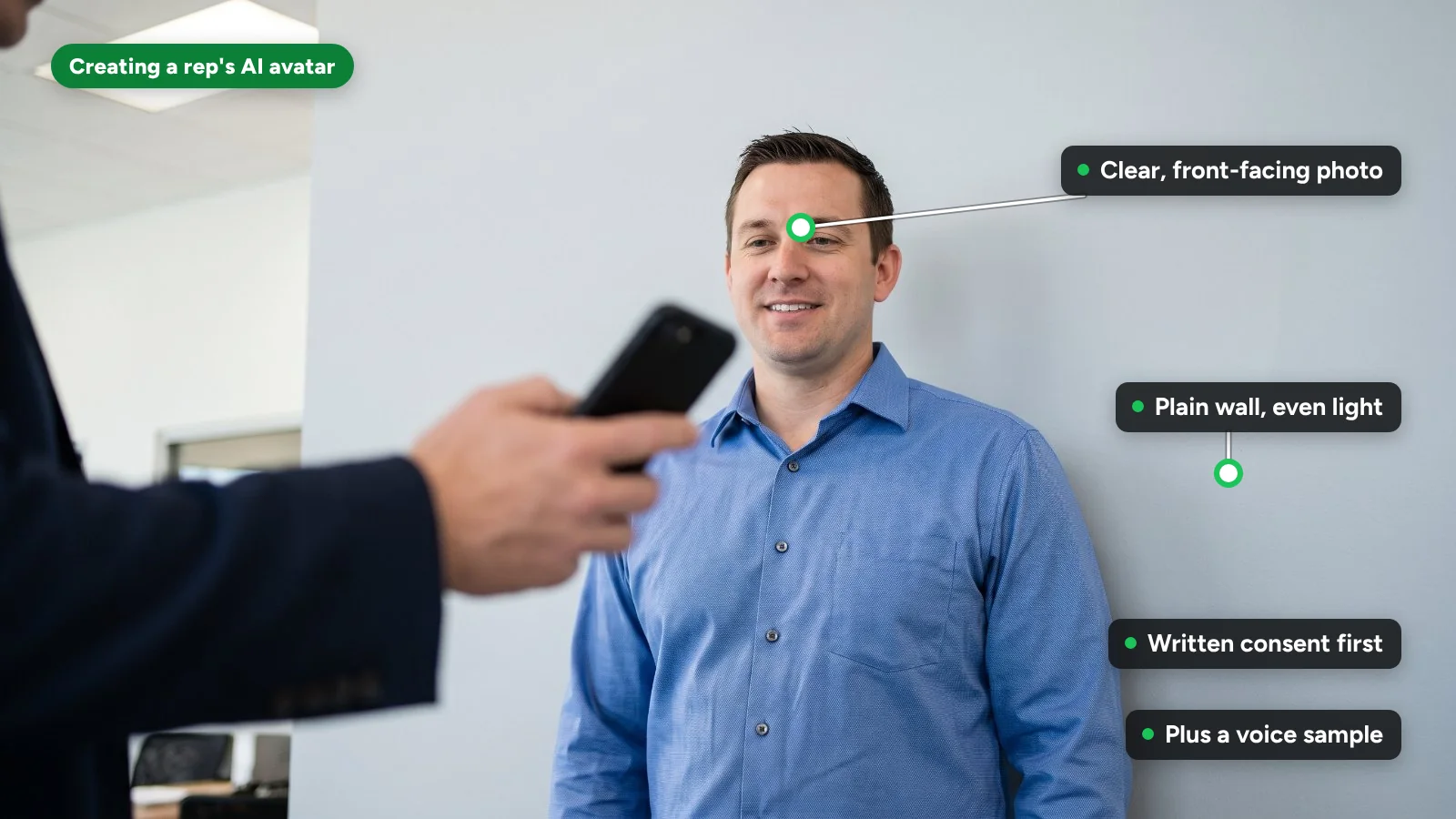
- Written consent. The rep agrees in writing to the use of their likeness and voice.
- Photo or video sample. A clear, front-facing image or short clip in good light.
- Voice sample. The rep reads a set script so the tool can model their voice.
- Review and approval. The vendor, the store or both check the avatar before use.
- Script control. The rep checks each script before sending.
AI avatar vs recorded video: which works better for follow-up?
| Factor | AI avatar video | Self-recorded video |
|---|---|---|
| Speed | Fast once the avatar exists: no recording or retakes | One to three minutes per video, plus walking to the car |
| Authenticity | Lower: the shopper is seeing a likeness, not a live take | Higher: real person, real car, real moment |
| Showing the car's condition | Limited to existing photos and video of the car | Can show a specific scratch, tire or feature on request |
| Consistency | Same delivery and framing every time | Varies with the rep's mood, light and noise |
| Languages | Can speak languages the tool supports | Only languages the rep speaks |
| Rep off shift | Can still go out with the rep's approval | Waits until the rep is back |
| Rep on camera | Not needed | Needed, which some reps avoid |
Recorded video is still stronger when the shopper asked to see something specific. Our guide to personalized video for car sales covers scripts and recording.
Do AI avatar videos work for car sales follow-up?
We are not aware of an independent study that measures reply or appointment rates for avatar videos on dealer leads. Adoption is growing: in Wyzowl's Video Marketing Statistics 2026 survey, 63% of video marketers said they had used AI to create or edit video, up from 51% a year earlier. That shows use, not results.
So test it. For four weeks, send half of your new internet leads an avatar first reply and half a text-only reply. Then compare reply, appointment and show rates. Log any shopper comment about the video being AI.
Where do AI avatar videos fit in the sales process?
| Lead stage | Avatar suitable? | Why |
|---|---|---|
| First reply to a new internet lead | Yes | Speed matters, and the content is predictable: name, car, availability, next step |
| Lead arrives after hours | Yes | Answers the same evening; the rep follows up in person the next morning |
| Follow-up after no reply | Yes | Something new to watch, such as a feature the shopper did not ask about |
| Lead prefers another language | Yes, if a speaker of that language can continue | An avatar can open the conversation, a person must carry it |
| Price, payment or trade negotiation | No | Numbers and commitments should come from the real rep or manager |
| Complaint, problem or delay | No | A likeness apologizing reads as indifference |
| Delivery and review request | No | This is the relationship moment; it needs the actual person |
For how AI fits other dealership departments, see our guide to AI for car dealerships.
What do the FTC and state laws say about AI avatars?
No federal law specifically bans sales avatars, but several rules shape how you use them:
- FTC deception standard. The FTC applies its ban on deceptive or unfair practices to AI like any other tool. Announcing its 2024 Operation AI Comply sweep, it said "there is no AI exemption from the laws on the books" (FTC, 2024). An avatar passed off as a live recording invites that scrutiny.
- Impersonation. The FTC Impersonation Rule prohibits materially and falsely posing as a business or government. In February 2024 the FTC proposed extending it to impersonation of individuals. Never create an avatar of anyone who has not consented.
- Fake testimonials. The FTC's 2024 rule on fake reviews covers testimonials by someone who does not exist, "such as AI-generated fake reviews." Never present an avatar as a customer.
- California. The B.O.T. Act makes it unlawful to use a bot online to mislead a person in California about its artificial identity in order to knowingly deceive them and encourage a sale. Disclosing the bot avoids liability, and the disclosure must be "clear, conspicuous." The law defines a bot as an automated online account, so a rep-sent video may fall outside it, but a clear label removes the question.
- Maine. Maine law bars using an AI chatbot "or any other computer technology" in trade in a way that may lead a reasonable consumer to believe they are dealing with a human, unless the consumer is clearly and conspicuously told they are not.
- Utah. Utah Code 13-77-103 requires a business using generative AI to interact with a consumer to disclose it when the consumer clearly asks whether they are dealing with AI.
- New York. A 2025 New York law, in effect since June 2026, requires an advertiser who knows an ad contains a synthetic performer to "conspicuously disclose" it. The definition covers AI performers not recognizable as any real person, which can include stock AI presenters in ads.
- Likeness and voice. States protect a person's likeness. New York Civil Rights Law 50, for example, requires written consent to use a living person's "likeness, or voice" for advertising or trade.
- Biometric privacy. Some states treat a face scan or voiceprint as biometric data. Illinois's Biometric Information Privacy Act requires written notice, a signed written release and a public retention policy before a voiceprint or face geometry scan is collected. Texas and Washington have their own biometric laws. Get the rep's release before the photo and voice sample are captured, not after.
- Calls. The FCC ruled in 2024 that calls using AI-generated voices are "artificial" under the TCPA. Do not use an avatar's voice in phone calls or voicemail without checking those rules.
Texting an avatar video also follows normal consent rules; see our automotive text messaging guide. This is general information, not legal advice. Check your approach with your compliance counsel.
How should you word an AI avatar disclosure?
Disclose in the message carrying the link and in the video itself:
- Text message. "Hi Maria, here's a quick AI video from me about the SUV you asked about. I'll call you myself when you're ready to see it."
- On-screen caption. "AI-generated video of Jordan Lee, sent by Jordan."
- If the shopper asks. "Yes, that was my AI avatar so you'd get an answer fast. Everything in it is accurate, and I'm happy to send a real walkaround."
What should a dealership agree with reps before using their avatar?
Put these points in writing before any avatar goes live:
- Scope. Which channels, languages and lead stages the avatar may be used for.
- Script approval. The rep approves what their avatar says.
- Departure and revocation. The avatar is deactivated when the rep leaves or withdraws consent, and nobody else sends videos as them.
What should you check when comparing AI avatar video software?
| What to check | Question to ask |
|---|---|
| Consent and approval flow | Is consent recorded, and is each avatar approved before use? |
| Likeness ownership when a rep leaves | Who controls the avatar, and can the store deactivate it the same day? |
| Voice quality | Does it sound like the rep on a phone speaker? |
| Languages | Which languages, and who answers the replies? |
| Script control | Can the rep edit every script before sending? |
| Length limits | What is the maximum video length? |
| Inventory media | Can the avatar appear over the actual car's photos or video? |
| CRM logging | Is each sent video and view logged to the lead? |
| Disclosure labels | Can you add an AI label to the video and landing page? |
Bring this list to every demo, including ours.
How does HelloRamp Engage handle AI avatar videos?
HelloRamp Engage offers both options: video replies recorded on camera or generated by the rep's AI avatar. For an avatar video, the rep picks the lead and vehicle, and Engage drafts the script from the lead and vehicle record. The avatar is composited over the car's inventory media, and the rep previews the video before sending it. Add the disclosure line from above to the message that carries the link.
To create an avatar, the rep adds a clear front-facing photo and records a voice sample of at least one minute, about five minutes, once. The HelloRamp.ai team reviews each avatar, and it is available only after approval. Each rep can keep several avatars, for example a Spanish-language one. Avatar videos run up to 30 seconds, reps are notified when a lead opens the video, and sent videos are logged against the lead. Avatar videos count as AI videos: Ultra includes them, and any plan can add a monthly pack, as shown on HelloRamp.ai pricing. HelloRamp Engage is available to dealerships across the US, Canada and India.
To try an avatar on your own leads alongside recorded video, start a free HelloRamp.ai trial.
Sources
- Pew Research Center: How Americans view AI and its impact on people and society (September 2025; survey June 9–15, 2025)
- Wyzowl: Video Marketing Statistics 2026 (2026; survey late 2025)
- FTC: FTC announces crackdown on deceptive AI claims and schemes (September 2024)
- eCFR: 16 CFR Part 461, Rule on impersonation of government and businesses (2024)
- FTC: FTC proposes new protections to combat AI impersonation of individuals (February 2024)
- FTC: Final rule banning fake reviews and testimonials (August 2024)
- California Business and Professions Code 17941 (Public.Law) (current)
- Maine Legislature: 10 M.R.S. 1500-DD (current)
- Utah Legislature: Utah Code 13-77-103, Required disclosures (2025)
- New York State Senate: S8420A, synthetic performer disclosure (signed December 2025)
- New York State Senate: Civil Rights Law Section 50 (current)
- Illinois General Assembly: Biometric Information Privacy Act, 740 ILCS 14 (current)
- FCC: FCC makes AI-generated voices in robocalls illegal (February 2024)
Frequently asked questions
What is an AI avatar video in car sales?
It is a short video in which a digital likeness of a salesperson, created from their photo and voice sample, speaks a script written for one shopper, usually over images of the car they asked about. It lets the rep send a personal reply without recording each video.
Do car shoppers have to be told a sales video uses an AI avatar?
Rules vary. California, Maine and Utah have bot or AI disclosure laws, and the FTC says there is no AI exemption from its rules against deception. A short label in the message and on screen is the simplest way to avoid misleading anyone. Check your approach with counsel.
How is an AI avatar of a car salesperson made?
The salesperson gives written consent, supplies a clear front-facing photo or short clip, and records a voice sample by reading a set script. The avatar is reviewed and approved before use, and the salesperson should check each script before a video is sent.
What happens to a salesperson's AI avatar when they leave the dealership?
That depends on the written agreement and the software. Best practice is to deactivate the avatar on the salesperson's last day so nobody sends videos in their name, and to confirm with the vendor who controls the likeness and voice data afterward.
When should a real salesperson take over from an AI avatar?
Once the conversation reaches price, payment, trade value, a complaint or a delay, the real salesperson or a manager should reply in person. Delivery, thank-you and review requests should also come from the actual person, because those moments build the relationship.
HelloRamp.ai is AI visual merchandising for car dealerships: guided capture, daily social publishing and personalised video replies to leads, in one platform. Book a walkthrough using your own vehicles.